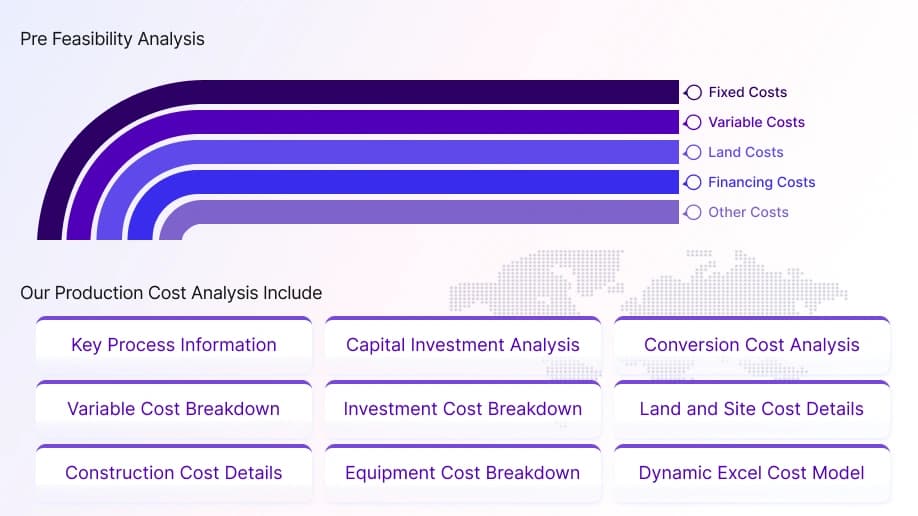
The report provides a detailed analysis essential for establishing a Calcium Phosphide production plant. It encompasses all critical aspects necessary for Calcium Phosphide production, including the cost of Calcium Phosphide production, Calcium Phosphide plant cost, Calcium Phosphide production costs, and the overall Calcium Phosphide production plant cost. Additionally, the study covers specific expenditures associated with setting up and operating a Calcium Phosphide production plant. These encompass production processes, raw material requirements, utility requirements, infrastructure needs, machinery and technology requirements, manpower requirements, packaging requirements, transportation requirements, and more.
Calcium Phosphide is most commonly used as a rodenticide since it effectively controls rodents by releasing toxic phosphine gas in their stomach after making contact with moisture. Due to its ability to produce bright flame and smoke, it also finds special applications in pyrotechnics to make fireworks, flares, ammunition, and so on. In a number of chemical processes Calcium Phosphide is used as a reductant and acts specifically on such chemicals as boron phosphide. It can be used in the formulation of pesticides. Because of its toxicity, handling and storage must therefore be monitored.
The market for Calcium Phosphide is driven by its usage for controlling rodents hence increasing its demand both in the agricultural and non-agricultural fields as a pesticide. Its usage in some forms of pest management other than controlling pests using insecticides, such as for fumigation to protect stored grains, and other applications for example against rodents, increases its demand in the market. Also, its use in the synthesis of other chemicals, such as phosphine and other phosphide compounds, is relevant to the growth of its demand in the chemical industry. Overall, industrial Calcium Phosphide procurement is influenced by its usage as a rodenticide in agricultural and non-agricultural settings, its utilization in other agricultural applications beyond pest control, and its employment in the chemical industry.
Raw Material for Calcium Phosphide Production
According to the Calcium Phosphide production plant project report, the key raw materials used in the production of Calcium Phosphide include calcium phosphate; calcium.
Production Process of Calcium Phosphide
The extensive Calcium Phosphide production cost report consists of the following major industrial production processes:
- Production from calcium phosphate: The production process of Calcium Phosphide involves the reaction of calcium phosphate with aluminium or carbon at high temperature to produce Calcium Phosphide.
- Production from metallic calcium: The process involves direct reaction of metallic calcium with phosphorus at high temperature to produce Calcium Phosphide.
Calcium Phosphide is a reddish-brown crystalline powder or gray lumps with an acetylene-like musty odor, having the molecular formula Ca3P2 and a molecular weight of 182.18 g/mol. It has a melting point of about 1600 °C, and it decomposes at its boiling point. It does not dissolve in alcohol and ether. When it combines with water, phosphine, a toxic and combustible gas, and calcium hydroxide are produced. Normally, phosphorus ignites on its own when it comes into contact with air. In most cases, this phosphine fire won't spread to nearby flammable material if there is an excess of water.