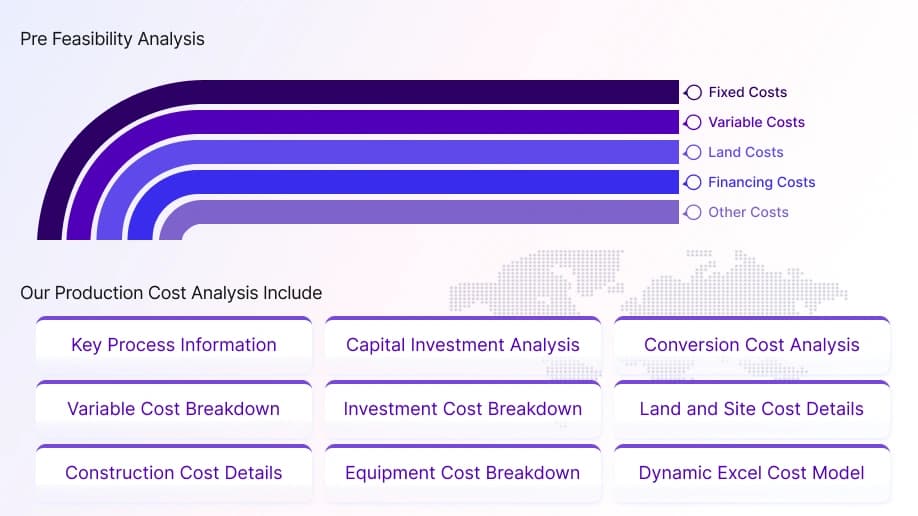
The report provides a detailed analysis essential for establishing a Ceftazidime production plant. It encompasses all critical aspects necessary for Ceftazidime production, including the cost of Ceftazidime production, Ceftazidime plant cost, Ceftazidime production costs, and the overall Ceftazidime production plant cost. Additionally, the study covers specific expenditures associated with setting up and operating a Ceftazidime production plant. These encompass production processes, raw material requirements, utility requirements, infrastructure needs, machinery and technology requirements, manpower requirements, packaging requirements, transportation requirements, and more.
Ceftazidime is an antibiotic used to treat various bacterial infections such as lower respiratory tract infections, urinary tract infections, skin and skin structure infections, bone and joint infections, bacterial septicemia, intra-abdominal infections (including peritonitis), gynecologic infections, and infections of the central nervous system such as meningitis. It is a member of the class of drugs called third-generation cephalosporin antibiotics with a broad-spectrum activity. It is utilized in combination with avibactam to treat infections such as complicated intra-abdominal infections (cIAI) and complicated urinary tract infections (cUTI), such as pyelonephritis. The combination is also used to treat hospital-acquired and ventilator-associated bacterial pneumonia (HABP/VABP).
The market for Ceftazidime is driven by its application as an antibiotic to treat various bacterial infections, which elevates its demand in the pharmaceutical and medical industries. The rising cases of antibiotic-resistant gram-negative bacterial infections are enhancing the demand for Ceftazidime. The drug’s ability to be utilized in combination with avibactam for several indications such as complicated intra-abdominal infections (cIAI) and complicated urinary tract infections (cUTI), such as pyelonephritis, amplifies its market presence.
Its employment in hospitals, mainly in the intensive care settings where bacterial infections are more common, contributes to its growing market value. The drug’s availability in generic versions makes it more accessible and affordable for patients, which fuels its demand even more. Overall, industrial Ceftazidime procurement is influenced by its application as an antibiotic in the pharmaceutical and medical industries, rising cases of antibiotic-resistant bacterial infections, combination therapy, its employment in hospital-acquired infections, and its availability in generic versions.
Raw Material for Ceftazidime Production
According to the Ceftazidime production plant project report, the key raw material used in the production of Ceftazidime includes cefalotin.
Production Process of Ceftazidime
The extensive Ceftazidime production cost report consists of the following major industrial production process:
- Production from cefalotin: The production process of Ceftazidime starts with the reaction of cefalotin with pyridine to form cefalosporidin. Cefalosporidin is reacted with trimethylchlorosilane in the presence of dimethylaniline and phosphorous pentachloride, followed by its treatment with 1,3-butandiol to form 7-amino-3-(1-pyridinomethyl)cef-3-en-carboxylic acid. The resulting compound undergoes acylation with acid chloride to give an intermediate. The intermediate is reacted with a mixture of formic and hydrochloric acids to remove both protective groups (triphenylmethyl and tert-butyl) to produce Ceftazidime.
Ceftazidime, commercially known as Avycaz, Fortaz, Tazicef, or Zavicefta, is a white to yellow crystalline powder having the molecular formula C22H22N6O7S2 and a molecular weight of 546.6 g/mol. It has a melting point in the range of 103-113 °C. It has a solubility of 5.73e-03 g/L and an estimated water solubility of 0.00573 mg/mL. The value of its partition coefficient, log P, is 1.60. The value of its dissociation constant, pKa (strongest acidic), is 2.42, and pKa (strongest basic) is 4.02.