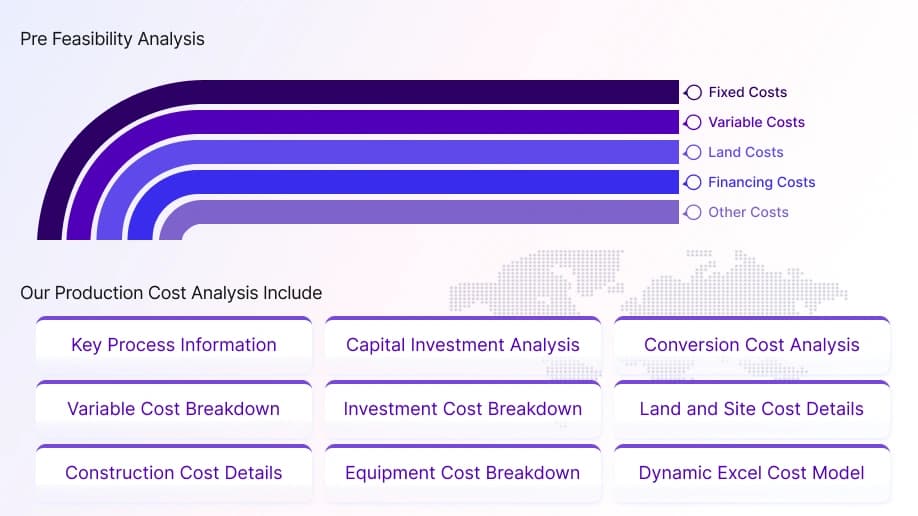
The report provides a detailed analysis essential for establishing a Cement production plant. It encompasses all critical aspects necessary for Cement production, including the cost of Cement production, Cement plant cost, Cement production costs, and the overall Cement production plant cost. Additionally, the study covers specific expenditures associated with setting up and operating a Cement production plant. These encompass production processes, raw material requirements, utility requirements, infrastructure needs, machinery and technology requirements, manpower requirements, packaging requirements, transportation requirements, and more.
Cement is an adhesive substance and a binding material used by itself or in concrete and mortar (Cement mixed with an inert material called aggregate) for a wide range of uses. It can be used in large masses like dams, for binding blocks, bricks, and stone in walls as well as surface renderings. Furthermore, concrete has a range of applications, specifically in construction, for instance, building road bases, tiles, pipes, and railroad ties, among other products. Also, it is crucial for building infrastructure and to secure it as well.
The market for Cement is driven by its usage on its own or in concrete and mortar for building roads, dams, bricks, stone, etc., which elevates its demand in the construction industry. Its utilization in tiles, pipes, and railroad ties amplifies its market appeal. The rising urbanization and growth of infrastructure boost its demand even more.
The rising investments in residential projects and government initiatives for affordable housing also contribute to its demand. Overall, industrial Cement procurement is influenced by its demand in the construction industry and housing and infrastructure development, the availability of its raw materials (sand, clay, bauxite, and limestone), the cost of its raw materials, the rising urbanization, growing investments in residential projects and affordable housings, and technological advancements.
Raw Material for Cement Production
According to the Cement production plant project report, the key raw materials used in the production of Cement include sand, clay, bauxite, and limestone.
Production Process of Cement
The extensive Cement production cost report consists of the following major industrial production process:
- Production from sand, clay, bauxite, and limestone: The production process of Cement starts with crushing the raw materials sand, clay, bauxite, and limestone into smaller pieces using a primary crusher. Secondary crushers are also used to further reduce the size. After crushing, the raw materials are blended in the right proportions to form a homogeneous mix before they enter the kiln. The raw materials are then dried to remove moisture and ground into a fine powder using mills. The fine powder is then fed into a rotary kiln, where it undergoes pyroprocessing to form oxides like calcium oxide (from limestone), silicon dioxide (from sand and clay), aluminium oxide, and iron oxide. These oxides form clinker. The clinker is heated and cooled and further mixed with gypsum and ground to produce Cement.
Cement is an adhesive substance and a binding material mainly used for building and civil engineering construction. It is a finely ground powder that is combined with water and set to form a hard mass. Setting and hardening take place via hydration, a chemical combination of water and cement compounds resulting in sub-microscopic crystals or a gel-like substance having a high surface area. There are two types of Cement: hydraulic and non-hydraulic. Cement has various forms and can be differentiated based on its properties like fineness, soundness, strength, consistency, setting time, loss of ignition, the heat of hydration, specific gravity, and bulk density. It also has several chemical properties, such as cohesive and adhesive properties, when mixed with water. The standard density of Cement is 1440 kg/m³.