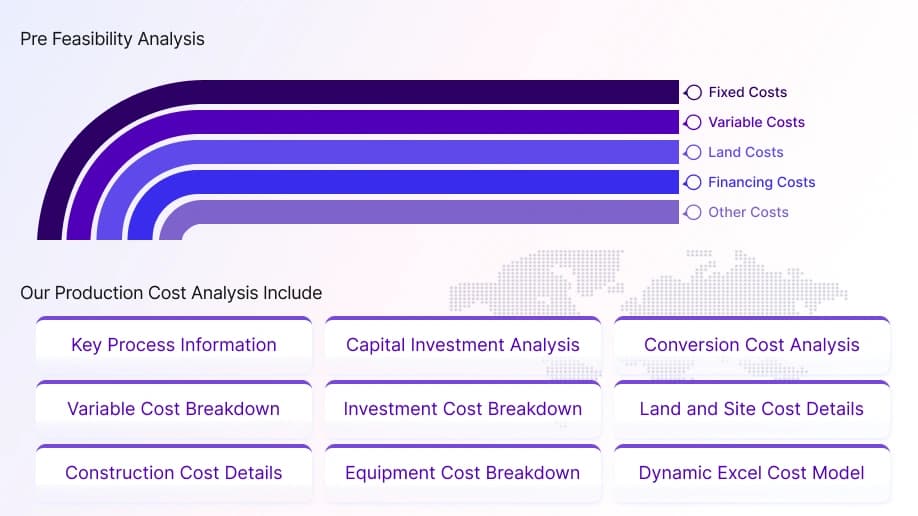
The report provides a detailed analysis essential for establishing a Clofibrate production plant. It encompasses all critical aspects necessary for Clofibrate production, including the cost of Clofibrate production, Clofibrate plant cost, Clofibrate production costs, and the overall Clofibrate production plant cost. Additionally, the study covers specific expenditures associated with setting up and operating a Clofibrate production plant. These encompass production processes, raw material requirements, utility requirements, infrastructure needs, machinery and technology requirements, manpower requirements, packaging requirements, transportation requirements, and more.
Clofibrate is a lipid-lowering drug used to treat primary dysbetalipoproteinemia, which is also known as Type III hyperlipidemia, in people who have metabolism disturbances related to specific fats in the blood that cause high levels of cholesterol and triglycerides. These medications help the body to metabolize fats better with the purpose of lowering the chances of heart disease. It is a fibric acid derivative used to lower the high cholesterol levels.
The procurement of Clofibrate is influenced by its utilization in the pharmaceutical and medical industries as an antihyperlipidemic medication. The widespread occurrence of hyperlipidemia is significantly increasing the demand for Clofibrate. It experiences a large demand from the elderly people as they are more inclined to be affected with high cholesterol and other ailments. Its ability to be used in combination with other antihyperlipidemic medications enhances its efficacy and makes it a preferred choice for treating patients with hyperlipidemia.
The ability of Clofibrate to get efficiently absorbed, ensuring steady release of the medication into the bloodstream, contributes to its demand. Its extended activity, due to its strong binding to plasma proteins, amplifies its market appeal. In addition, it has a long half-life which reduces the frequency of drug administration, thereby increasing patient compliance. Overall, industrial Clofibrate procurement is influenced by its utilization in the pharmaceutical and medical industries, rising cases of hyperlipidemia and related health issues, the aging population, its compatibility with other drugs, steady release, extended activity, long half-life, patient adherence, and regulatory approvals.
Raw Material for Clofibrate Production
According to the Clofibrate production plant project report, the key raw materials used in the production of Clofibrate include 4-chlorophenol-acetone-chloroform.
Production Process of Clofibrate
The extensive Clofibrate production cost report consists of the following major industrial production process:
- Production from 4-chlorophenol, acetone, and chloroform: The production process of Clofibrate starts with the reaction of 4-chlorophenol, acetone, and chloroform in the presence of an alkali such as NaOH to form chlorethone-trichloro-tert-butyl alcohol. The alcohol derivative is converted into (4-chlorophenoxy)trichloro-tert-butyl ether under suitable reaction conditions. The ether undergoes hydrolysis to give the acid derivative. The acid is subjected to esterification with ethanol in the presence of an inorganic acid to produce Clofibrate.
Clofibrate, commercially known as Atromid-S, is a colorless to pale yellow solid having the molecular formula C12H15ClO3 and a molecular weight of 242.70 g/mol. It has a faint characteristic odor and taste. It has a boiling point in the range of 148-150 °C. Its melting point is measured in the range of 118-119 °C. It is insoluble in water and soluble in chloroform. It has a log P value of around 3.3. The value of its dissociation constant, pKa, is -4.9. The ethyl ester of clofibric acid is called Clofibrate. It functions as a PPARalpha agonist, geroprotector, antilipemic, and anticholesteremic medication. It is an ethyl ester, an aromatic ether, and a member of the monochlorobenzene family.