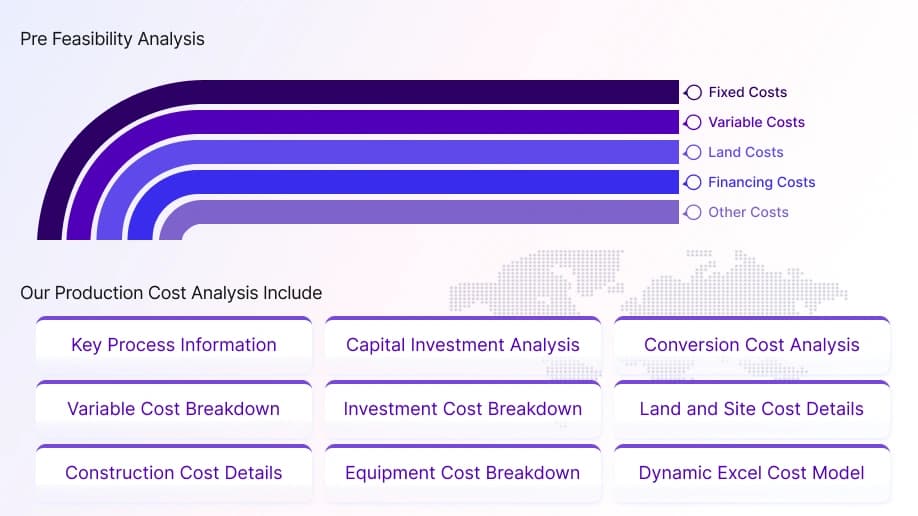
The report provides a detailed analysis essential for establishing a coal production plant. It encompasses all critical aspects necessary for coal production, including the cost of coal production, coal plant cost, coal production costs, and the overall coal production plant cost. Additionally, the study covers specific expenditures associated with setting up and operating a coal production plant. These encompass production processes, raw material requirements, utility requirements, infrastructure needs, machinery and technology requirements, manpower requirements, packaging requirements, transportation requirements, and more.
Coal is a combustible sedimentary rock that is mainly associated with petrochemical production, metal processing, and power generation activities. It is used to generate power, which is used across the household and industrial sectors, furthering its commercial demand. In addition, it is used for purging and blanketing to get protection against several contaminants. It prevents combustible dust explosions and enables safe storage of flammable products.
It is largely used to power chemical and metal processing plants. Coal serves as a fuel for power plants to generate electricity and can be converted into coal gas and coal liquid, which is further used as fuel varieties. It serves as a building block in the chemical industry to produce synthetic fuels. Moreover, it can be used in various other sectors, including healthcare, paper, construction, and chemical industries.
The coal industry is growing exponentially owing to its growing demand for electricity generation. Its need for gas blanketing and refineries is expanding along with the demand from other industries such as food and beverages, healthcare, paper, metal, construction, and chemical industries. Therefore, its demand plays a significant role in its market growth.
Moreover, industrial coal procurement is also dependent upon its demand as a fuel variety along with other factors, including its application as a raw material to various crucial industrial products, its prices, distribution, socioeconomic factors, production, etc. Hence, changes in these factors, specifically in its demand in metal, paper, food, beverages, pharmaceutical, and chemical industries, along with its market prices and supply, directly impact its procurement across various regions.
Production Process of Coal
The extensive coal production cost report consists of the major industrial production process:
- By Mining: Coal is a combustible compound, manufactured by surface mining technique.
Coal is a non-renewable fossil fuel that is formed after millions of years from the remains of ancient organisms. It is a sedimentary rock that has a black or brownish-black color. It is made up of carbon and hydrocarbons, containing energy that gets released via combustion (burning).
This process is further used to generate electricity. It is formed in between layers of dirt and rock that have been covered by plants for more than millions of years. The pressure formed as a result is heated, turning the plants into coal, as it is known.
The substance is classified into anthracite, bituminous, subbituminous, and lignite. Coal does not have a fixed chemical composition and crystal structure. Its density ranges between 1.1 to about 1.5 megagrams per cubic meter or grams per cubic centimeter. It is denser than water but less dense than most rocks and mineral matter.
It has porosity (pore sizes and pore distribution), which is important for coke production, liquefaction, gasification, and high surface area carbon production to purify gases and water. It also has good reflectivity and features like hardness, grind ability, ash fusion temperature, and free swelling index.