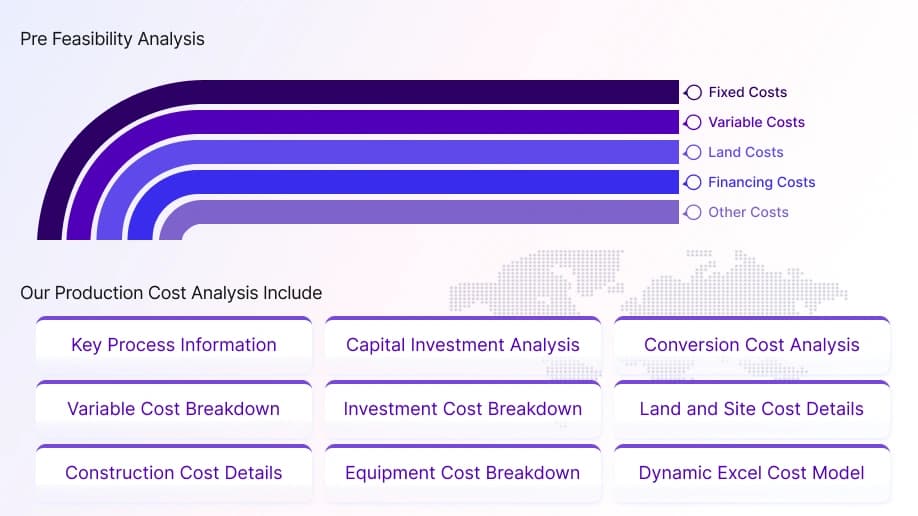
The report provides a detailed analysis essential for establishing a copper production plant. It encompasses all critical aspects necessary for copper production, including the cost of copper production, copper plant cost, copper production costs, and the overall copper production plant cost. Additionally, the study covers specific expenditures associated with setting up and operating a copper production plant. These encompass production processes, raw material requirements, utility requirements, infrastructure needs, machinery and technology requirements, manpower requirements, packaging requirements, transportation requirements, and more.
Copper is a soft, electrically, and magnetically conductive material largely used in electronic, electrical, metal, medical, automotive, and other commercial sectors. It is used in making electrical equipment, in construction for roofing and plumbing, and in commercial machinery like heat exchangers and alloys, including brass, bronze, copper-tin-zinc, etc. Moreover, it is also an excellent option for electrical operations.
Copper possesses excellent conductivity, versatility, and malleability. Hence, it is largely used to draw wires and install them in electronic mediums for electrical operations. Furthermore, it finds use in making a wide range of goods like cooking foil, cans, and saucepans, as well as electricity cables, planes, and space vehicles. It can be used for chemical vapor deposition, which finds use in the production of semiconductors involving the deposition of thin copper films from a gas-phase precursor.
The market for copper is mainly strengthened by its strong demand in the metal, electrical, electronic, and medical industries. Its usage in the production of metal wires, for electrical operations, and installations in electronics drives its demand in the market. Moreover, its usage in the production of alloy metals and semiconductors, which are further used to produce metal products, including household appliances, vehicles, automotive parts, etc., boosts its demand in the metal industry. Moreover, its usage in chemical reactions for synthesizing its derivatives, including copper oxide, sulfate, and more, fuels its demand in the chemical industry.
Industrial copper procurement is highly dependent upon the variations observed in its demand as a metal element in chemical, metal, electronic, and electrical industries. Other factors such as its market prices, extraction and production cost of copper-mineral ores, regional availability of copper ore (specifically in China, Indonesia, etc.), along with its trade, distribution, etc., altogether impact its procurement around the world. Therefore, these factors, including its demand as a metal element, market prices, supply, and logistics, are essential to govern its procurement.
Raw Material for Copper Production
According to the copper production plant project report, the key raw material for copper production includes copper sulfide ore; copper oxide ore.
Production Process of Copper
The extensive copper production cost report consists of the major industrial production process:
- From Copper Sulfide Ore: Copper is a metal variety produced by using copper sulfide ores. In this process, the metal sulfide ores are processed through crushing, froth flotation, froth settlement, filtering, smelting, and refining to obtain copper as the final product.
- From Copper Oxide Ore: Copper metal is produced by using copper oxide ores, which is processed into fine powder and is leached using an acidic medium. It is then processed through solvent extraction, electrolysis, and purification to obtain copper metal as the end product.
Copper (Cu) is a chemical element belonging to the Group 11 (Ib) of the periodic table. It is present in a free metallic state in nature. It is crucial for the health of animals, humans, and plants and is also integral to the human diet. It is abundantly found in foods like almonds, beans, chocolate, broccoli, garlic, peas, soybeans, whole wheat products, and seafood.
Copper is a reddish-coloured metal with a face-centered cubic crystalline structure. It mirrors orange and red light and also absorbs other frequencies in the visible spectrum because of its band structure. It is softer than zinc and may be polished to have a brighter finish. It has various properties, like being highly ductile, which is also a great heat and electricity conductor. It can be recycled without losing properties, making it highly sustainable.its respective melting and boiling points are 1083 °C (1981 °F) and 2567 °C (4653 °F). its atomic mass is 63.546 g.mol-1 at 20°C and its density is 8.96 at 20 °C (68 °F).