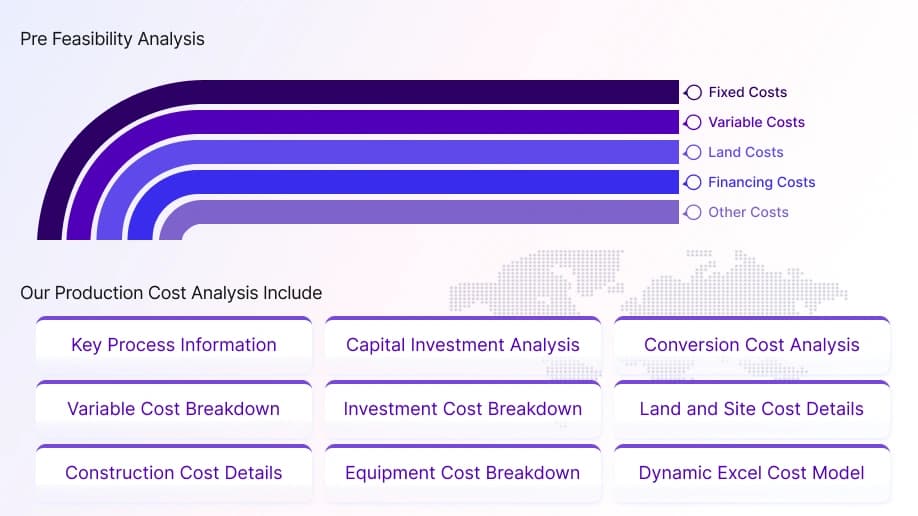
The report provides a detailed analysis essential for establishing a cumene production plant. It encompasses all critical aspects necessary for cumene production, including the cost of cumene production, cumene plant cost, cumene production costs, and the overall cumene production plant cost. Additionally, the study covers specific expenditures associated with setting up and operating a cumene production plant. These encompass production processes, raw material requirements, utility requirements, infrastructure needs, machinery and technology requirements, manpower requirements, packaging requirements, transportation requirements, and more.
Cumene, also known as isopropylbenzene, is a volatile organic compound that is mainly used to produce plastic or works as a solvent and a thinner for paints, lacquer, and enamel. It is employed in several petroleum products. Furthermore, it has several end-uses owing to its distinct properties, such as its use in household products, pesticides, etc.
It is also abundantly used to make phenol and acetone, which are further used in plastic production. It also facilitates the production of many products like detergents, rubber, pulp & paper, iron, and steel. Also, it finds use as a catalyst in the synthesis of acrylic and polyester-type resins.
The market for cumene is majorly driven by its applications in chemical production and plastic industries, as it is extensively used in the manufacture of other chemicals such as acetone, phenol, acetophenone, etc., which contributes to its market expansion.
It is also extensively used as a solvent in lacquers, paint, and enamels, which further props up its demand in the paint & coating industries. Moreover, it is also utilized in the production of rubber, paper, iron, and steel, which amplifies its demand in rubber, pulp & paper, and metal industries, respectively. Additionally, the availability and cost of production of cumene’s feedstock (benzene and propylene), cumene market prices, distribution (including trading and shipping), logistics, environmental regulations, safety standards, etc., are some of the elements that influence an industrial cumene procurement.
Raw Material for Cumene Production
According to the Cumene production plant project report, the major raw materials for Cumene production include Benzene-Propylene.
Production Process of Cumene
The extensive Cumene production cost report consists of the following industrial production process:
- Production via Friedel–Crafts Alkylation: The process involves the alkylation of benzene and propylene in the presence of any one of the catalysts including solid phosphoric acid (SPA) supported on alumina, zeolites (such as ZSM-5), and aluminum chloride, namely solid phosphoric acid (SPA) to produce cumene.
Cumene is the common name for isopropylbenzene, an organic compound. It is an alkylbenzene where the one hydrogen atom of benzene is replaced by an isopropyl group. It is found in crude oil and refined fuels and is a component of processed high-octane gasoline. Cumene looks like a clear, colourless liquid with a sharp, penetrating aromatic odour.
It is less dense than water and is insoluble in it; however, it is miscible with ethanol, ethyl ether, acetone, benzene, petroleum ether, and carbon tetrachloride. Its vapors are heavier than air. It is slightly toxic upon inhalation, ingestion, and skin absorption. It has a Flash point of 115 °F. It is a volatile liquid with a boiling and melting point of152.4 °C and −141 °C, respectively.