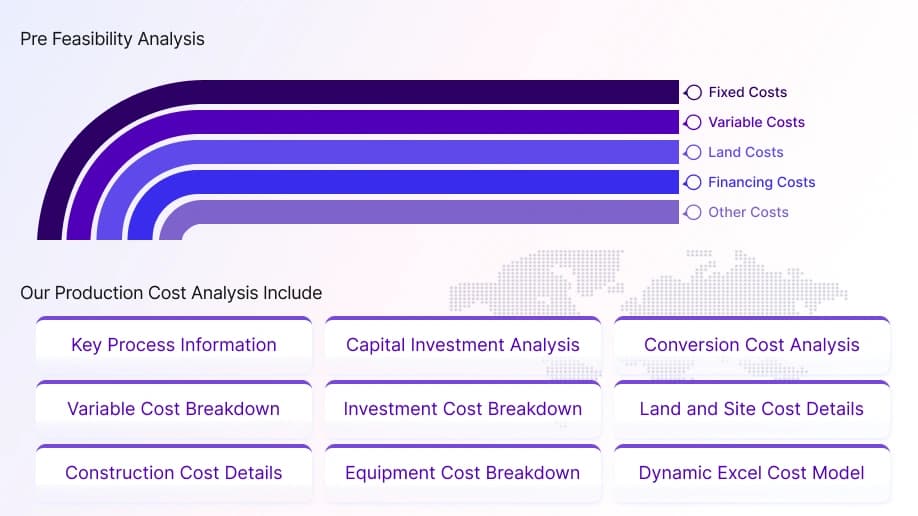
The report provides a detailed analysis essential for establishing a Dextrose production plant. It encompasses all critical aspects necessary for Dextrose production, including the cost of Dextrose production, Dextrose plant cost, Dextrose production costs, and the overall Dextrose production plant cost. Additionally, the study covers specific expenditures associated with setting up and operating a Dextrose production plant. These encompass production processes, raw material requirements, utility requirements, infrastructure needs, machinery and technology requirements, manpower requirements, packaging requirements, transportation requirements, and more.
Dextrose is a simple sugar used in baking products as a sweetener and has applications in products like processed foods and corn syrup. In food-related applications, it is employed as a sweetener or preservative. It is also part of the fermentation process during wine production. In addition, it preserves food, extending the shelf life of packaged foods.
Furthermore, it is extensively used in the medical industry for many medical applications, like an IV solution to treat dehydration and low blood sugar levels. It is used to give total parenteral nutrition (TPN) to people who are unable to absorb or get carbohydrates, amino acids, and fats through their gut. Other applications that employ Dextrose and boost its demand include bath products, skin and hair care products, makeup, and animal feed.
The market for Dextrose is driven by its application as a sweetener in a variety of food products, including candies, baked goods, and beverages, which elevates its demand in the food and beverage industries. Also, its use as a bulking agent, emulsifier, and thickening agent, enhancing the texture and shelf life of food products, elevates its demand even more. Its utilization in intravenous solutions, where it provides essential glucose and energy to patients unable to consume food orally, amplifies its demand in the pharmaceutical and medical industries.
Its incorporation in items such as bath products, skin and hair products, and makeup fuels its market growth in cosmetics and personal care industries. Overall, industrial Dextrose procurement is influenced by its application as a sweetener, preservative, emulsifier, thickening agent, and bulking agent in the food and beverage industries, its utilization in downstream industries, the availability of its raw material (starch), the cost of its raw material, technological advancements, and health trends.
Raw Material for Dextrose Production
According to the Dextrose production plant project report, the key raw material used in the production of Dextrose includes starch.
Production Process of Dextrose
The extensive Dextrose production cost report consists of the following major industrial production process:
- Production from hydrolysis of starch: The production process of Dextrose occurs through the hydrolysis of starch. Starch is hydrolyzed with the help of enzymes such as glucoamylase, which breaks the complex molecule into Dextrose. Dextrose is separated from any remaining enzymes or starch to obtain the final product.
Dextrose (C6H12O6) is a simple sugar that is the D-isomer of glucose or blood sugar. Dextrose appears to be a white crystalline powder that has no odour and a clean, sweet taste. It is water-soluble, with a solubility of 91 g/100 ml. Its respective molar mass and density are 180.16 g/mol and 1.54 g/cm3. It has a melting point in the range of 146 °C. It has a high glycemic index and can give rise to the levels of blood sugar quickly, acting as a good source of energy.