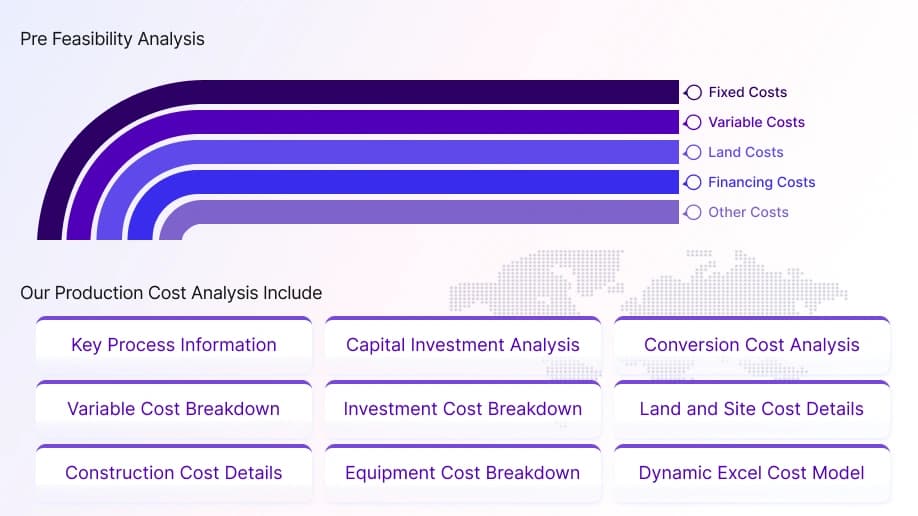
The report provides a detailed analysis essential for establishing a Didanosine production plant. It encompasses all critical aspects necessary for Didanosine production, including the cost of Didanosine production, Didanosine plant cost, Didanosine production costs, and the overall Didanosine production plant cost. Additionally, the study covers specific expenditures associated with setting up and operating a Didanosine production plant.
These encompass production processes, raw material requirements, utility requirements, infrastructure needs, machinery and technology requirements, manpower requirements, packaging requirements, transportation requirements, and more.
Didanosine belongs to the group of anti-viral drugs and serves for the treatment of HIV (Human Immunodeficiency Virus) disease. It is part of a group of drugs known as reverse transcriptase inhibitors, which prevent a virus called reverse transcriptase that HIV requires to reproduce in the body.
It slows down this enzyme to decrease the virus development in the organism and help to keep the immune system functioning. It is employed together with other antiretroviral drugs as part of a complete HIV treatment regimen and this combination therapy has proved to be more effective in preventing the virus from advancing to AIDS.
The procurement of Didanosine is influenced by its application in the pharmaceutical and medical industries as an antiviral medication used to treat HIV-1 infection. The widespread occurrence of viral infections is significantly increasing the demand for Didanosine. Didanosine has been evidenced to enhance the management of HIV infection with sustained declines in plasma HIV RNA levels and CD4+ cell count increase, which increases the demand.
It is taken along with at least one other antiretroviral substance to increase its therapeutic effect. Its enduring involvement in the treatment management programmes is partly attributed to its ability to be used in compound drug administration, thus enhancing its market appeal. Didanosine has several dosages that can be followed flexibly depending on the needs of the patient. The drug can be administered once or twice daily.
The dosing options have been stretched by the fact that there are both immediate-release and extended-release forms of the drug, and this is what boosts its demand. Overall, industrial Didanosine procurement is influenced by its application in the pharmaceutical and medical industries as an antiviral medication, rising cases of HIV-1 infections, combination therapy, better efficacy, fewer side effects, better tolerability, flexible dosing schedules, and regulatory approvals.
Raw Material for Didanosine Production
According to the Didanosine production plant project report, the key raw material used in the production of Didanosine includes 2′-deoxyinosine.
Production Process of Didanosine
The extensive Didanosine production cost report consists of the following major industrial production process:
- Production from 2′-deoxyinosine: The production process of Didanosine starts with the protection of the 5′ hydroxyl group of 2’-deoxyinosine through a benzoylation reaction in the presence of pyridine to form 5′-O-benzoyl-2′-deoxyinosine. This compound is reacted with 1,1'-Thiocarbonyldiimidazole , resulting in the addition of the thiocarbonylimidazole group at 3′ position to give an intermediate. The intermediate undergoes deoxygenation at 3′ position to form 5′-O-benzoyl-2′,3′-dideoxyinosine. Finally, the 5′ hydroxyl group of the compound is deprotected by treating it with anhydrous methanol and ammonia to produce Didanosine.
Didanosine, commercially known as Videx, is a white and hygroscopic crystalline powder having the molecular formula C10H12N4O3 and a molecular weight of 236.23 g/mol. It has a melting point in the range of 160-163 °C. It has a water solubility of 15.8 mg/mL. It has an estimated water solubility of 6.58 mg/mL. The value of its dissociation constant, pKa, is 9.13. It is a nucleoside analog reverse transcriptase inhibitor (NRTI) used to treat HIV-1 infection.