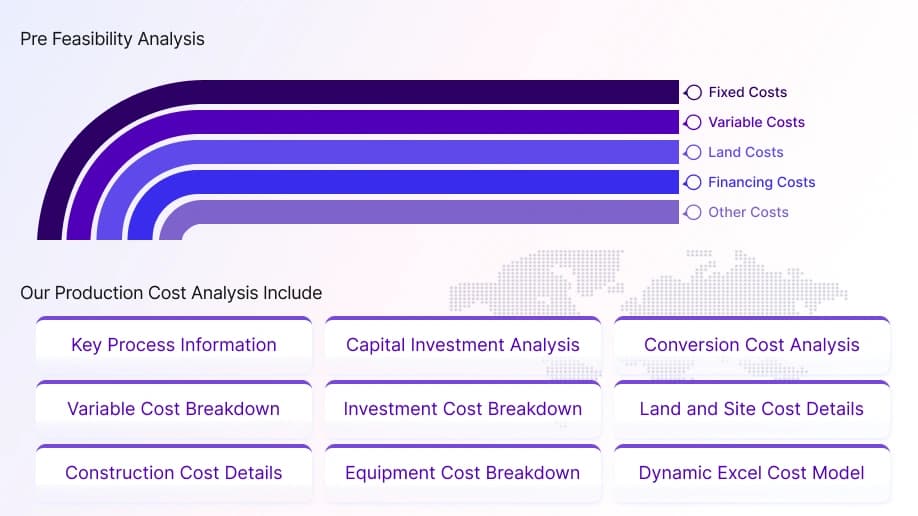
The report provides a detailed analysis essential for establishing a Doxapram production plant. It encompasses all critical aspects necessary for Doxapram production, including the cost of Doxapram production, Doxapram plant cost, Doxapram production costs, and the overall Doxapram production plant cost. Additionally, the study covers specific expenditures associated with setting up and operating a Doxapram production plant. These encompass production processes, raw material requirements, utility requirements, infrastructure needs, machinery and technology requirements, manpower requirements, packaging requirements, transportation requirements, and more.
Doxapram is a medication used to help people with chronic obstructive pulmonary disease (COPD) to restore normal breathing during acute episodes when their breathing becomes very difficult. It works quickly to stimulate the respiratory system and increase breathing rate. It does this by acting on the brain's respiratory center, which controls breathing. Additionally, it is also utilized to help patients who have trouble breathing after surgery, especially if their breathing is slow due to anesthesia or pain medications. Moreover, it can also be used to reduce shivering that some patients experience after surgery. It is a central respiratory stimulant belonging to the class of pyrrolidin-2-ones.
The market for Doxapram is driven by its application as a central respiratory stimulant used for the treatment of acute respiratory insufficiency in COPD patients, which significantly promotes its demand in the pharmaceutical and medical industries. The widespread occurrence of respiratory disorders is significantly increasing the demand for Doxapram.
Additionally, its ability to manage respiratory depression after surgeries, particularly in patients recovering from anesthesia, enhances its market as a supportive treatment. Moreover, its role as a central nervous system stimulant in emergency medicine, especially for reversing drug-induced respiratory depression (such as from opioids), further boosts its market presence. Overall, industrial Doxapram procurement is influenced by its application in the pharmaceutical and medical industries, rising cases of respiratory disorders, postoperative care, emergency usage, increasing healthcare awareness, and regulatory approvals.
Raw Material for Doxapram Production
According to the Doxapram production plant project report, the key raw material used in the production of Doxapram includes Diphenylacetonitrile.
Production Process of Doxapram
The extensive Doxapram production cost report consists of the following major industrial production process:
- Production from Diphenylacetonitrile: The production process of Doxapram starts with the alkylation of Diphenylacetonitrile with 1-ethyl-3-chlorpyrrolidine in the presence of sodium amide to form (1-ethyl-3-pyrrolidinyl) diphenylacetonitrile. The nitrile group of the compound undergoes acid hydrolysis to give (1-ethyl-3 pyrrolidinyl)diphenylacetic acid. The resulting compound is further reacted with phosphorous tribromide leading to the rearrangement with an opening of the pyrrolidine ring and the subsequent closing of the pyrrolidinone ring to form 1-ethyl-4-(2-bromoethyl)-3,3-diphenyl-2-pyrrolidinone. Finally, the bromine atom is substituted with a morpholine group to produce Doxapram as the final product.
Doxapram, commercially known as Dopram, is a white to off-white crystalline powder having the molecular formula C24H30N2O2 and a molecular weight of 378.5 g/mol. It has a melting point in the range of 217-219 °C. It is sparingly soluble in water and almost insoluble in ether. It has an estimated water solubility of 0.0343 mg/mL. It has a log P value of 3.6. The value of its dissociation constant, pKa, is 7.23. It remains stable in light and air in its hydrochloride form. It is a central respiratory stimulant used to treat acute respiratory insufficiency in COPD patients.