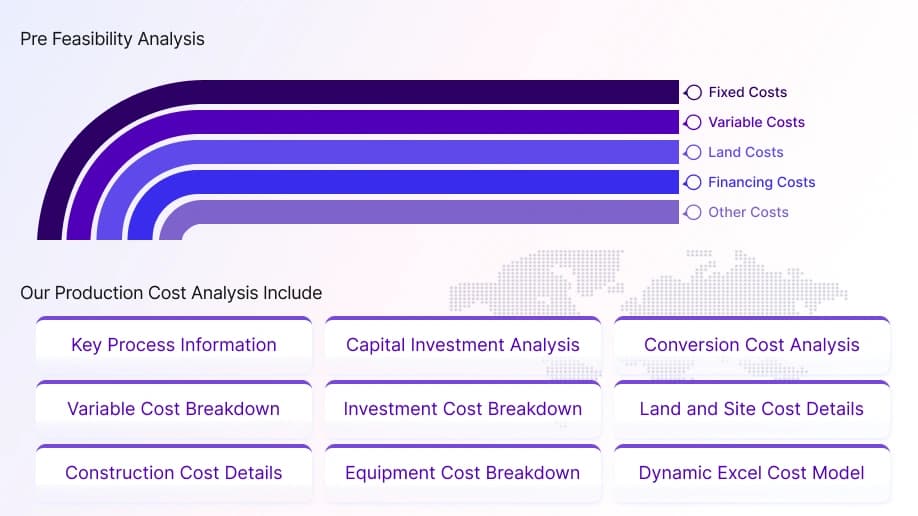
The report provides a detailed analysis essential for establishing a Dysprosium Iron Alloys production plant. It encompasses all critical aspects necessary for Dysprosium-Iron Alloys production, including the cost of Dysprosium-Iron Alloys production, Dysprosium-Iron Alloys plant cost, Dysprosium-Iron Alloys production costs, and the overall Dysprosium-Iron Alloys production plant cost. Additionally, the study covers specific expenditures associated with setting up and operating a Dysprosium-Iron Alloys production plant. These encompass production processes, raw material requirements, utility requirements, infrastructure needs, machinery and technology requirements, manpower requirements, packaging requirements, transportation requirements, and more.
Dysprosium-iron alloy is a high-purity rare earth alloy that constitutes dysprosium and iron in different amounts. It is widely used as a master alloy to improve the properties of Nd-Fe-B (neodymium-iron-boron) permanent magnets and enhance their performance. It also finds application as the raw material in the production of Nd-Fe-B permanent magnet alloys. It is also used as a smelting additive. It is often used in grain refining and hardening of various metal alloys by improving existing properties like ductility and machinability. It is also utilized in the production of magnetostrictive materials, such as Terfenol-D. It is also used as a magnetic material in the production of magnetic storage devices and sensors.
The market for Dysprosium-Iron alloys is driven by its demand as a master alloy to enhance the magnetic properties of neodymium-iron-boron (NdFeB) magnets. Its utilization as a master alloy for hardening and grain refining processes to improve the overall performance of the alloy makes it a sought-after commodity in the market. Its involvement in the production of magnetic storage devices, sensors, and magnetostrictive materials also contributes to its demand in the data storage, electronics, automation, and materials science and engineering industries. Additionally, industrial dysprosium-iron alloy procurement is governed by its demand from data storage, automation, electronics, and material science industries, where its unique properties can significantly enhance the performance of alloys. The demand from industries that rely on high-performance magnets, such as the automotive, electronics, and metalworking sectors, also impacts its procurement.
Raw Material for Dysprosium Iron Alloys Production
According to the Dysprosium Iron Alloys production plant project report, the major raw materials for Dysprosium-Iron Alloys production include Trifluoro-Dysprosium and Lithium Fluoride.
Production Process of Dysprosium Iron Alloys
The extensive Dysprosium-Iron Alloys production cost report consists of the following industrial production process:
- Production via Electrolysis: This method of production involves the process of electrolysis for the synthesis of Dysprosium-Iron Alloys. The synthesis begins with the electrolysis of the equimolar combination of trifluoro-dysprosium and lithium fluoride electrolyte at the temperature of 1050°C to produce Dysprosium-Iron Alloys as the final product.
Dysprosium Iron Alloy (DyFe), also known as dysprosium ferroalloy, ferro dysprosium, ferro dysprosium, or Dysprosium-iron, is among the many high-purity rare earth alloys comprising dysprosium and iron in varying proportions. The density of the compound is between 7.5-8.5 g/cm3. It is available in several forms, including plates, sheets, discs, rods, foils, tubes, ingots, and other shapes. Dysprosium Iron Alloy looks like a solid that is silver-grey and has a metallic lustre and cast block appearance. The alloy is composed of Dysprosium (a rare silvery earth metal) and Iron (a metal).