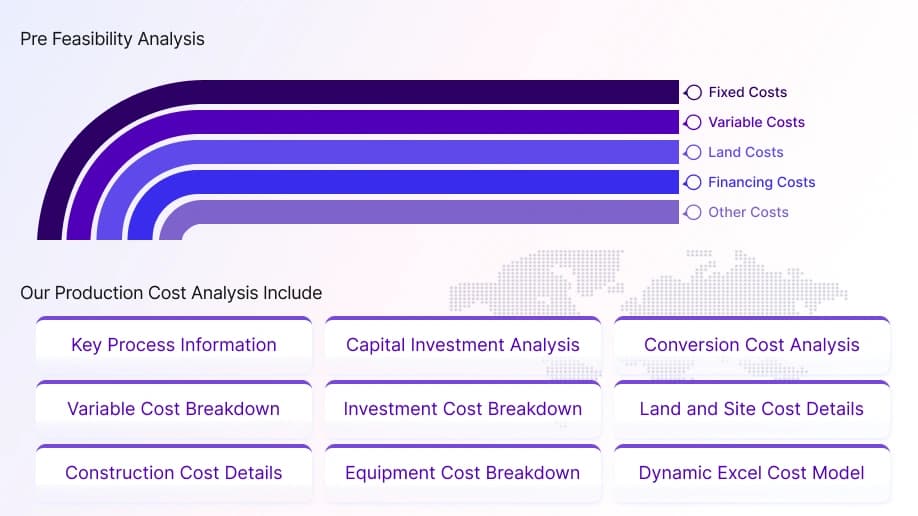
The report provides a detailed analysis essential for establishing an Enoxaparin production plant. It encompasses all critical aspects necessary for Enoxaparin production, including the cost of Enoxaparin production, Enoxaparin plant cost, Enoxaparin production costs, and the overall Enoxaparin production plant cost. Additionally, the study covers specific expenditures associated with setting up and operating an Enoxaparin production plant. These encompass production processes, raw material requirements, utility requirements, infrastructure needs, machinery and technology requirements, manpower requirements, packaging requirements, transportation requirements, and more.
Enoxaparin is a drug that has several clinical applications because of its blood clot-preventing properties. It works by getting attached to a protein in the blood that blocks an important factor that is responsible for blood clots. It is used in deep vein thrombosis to block the formation of blood clots in patients who are going through surgeries. It is helpful for bedridden patients or those having limited mobility due to certain medical conditions. It is utilized in the treatment of DVT with or without pulmonary embolism, and it dissolves already existing clots to avoid further complications. Enoxaparin is used in managing acute coronary syndromes in combination with aspirin to decrease ischemic events. It is also employed to prevent thrombotic complications during percutaneous coronary intervention procedures.
The market for Enoxaparin is driven by several factors. Its use in preventing blood clots in various cases contributes to its growing demand. Its utilization as an anticoagulant in deep vein thrombosis in patients during surgery and after they are on limited mobility makes it a popular medication among healthcare providers. Its utilization in managing acute coronary syndromes, when used in combination with aspirin, further contributes to its demand. Thus, industrial Enoxaparin procurement is influenced by its usage as an anticoagulant for treating thrombosis, along with increasing surgical procedures, preference for branded formulations, and research and development in anticoagulant therapies.
Raw Material for Enoxaparin Production
According to the Enoxaparin production plant project report, the key raw materials used in the production of Enoxaparin include Bovine Lung Tissue-Nitrous Oxide.
Production Process of Enoxaparin
The extensive Enoxaparin production cost report consists of the following major industrial production process:
- From Bovine Lung Tissue and Nitrous Oxide: The production process for Enoxaparin has several steps. First, heparin is extracted from bovine lung tissue. After that, it goes through chemical depolymerization using nitrous oxide forming oligosaccharides. These oligosaccharides undergo N-acetylation followed by sulfation of the oligosaccharides, forming Enoxaparin. The product is purified using chromatography to obtain pure Enoxaparin.
Enoxaparin's average molecular weight is in the range of 4000-5000 Da. It is freely soluble in water and it has a large distribution volume of about 4.3–5 liters, close to the volume of total blood in the human body, and it strongly binds to plasma proteins. Its absolute bioavailability is 100%, and it takes 3-5 hours to reach anti-factor Xa activity peak levels, which is considerably delayed from the time of dosing. It undergoes metabolism in the liver and is excreted through the kidneys with an effective half-life of 4–7 hours in adults, based on the type of dosage. All these physical and chemical properties combine to make Enoxaparin a clinically effective anticoagulant.