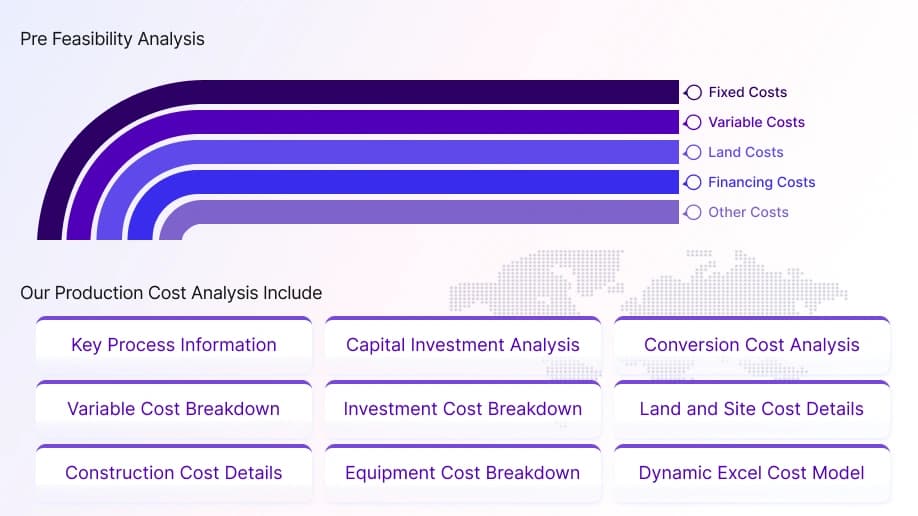
The report provides a detailed analysis essential for establishing an EPDM Rubber production plant. It encompasses all critical aspects necessary for EPDM Rubber production, including the cost of EPDM Rubber production, EPDM Rubber plant cost, EPDM Rubber production costs, and the overall EPDM Rubber production plant cost. Additionally, the study covers specific expenditures associated with setting up and operating an EPDM Rubber production plant. These encompass production processes, raw material requirements, utility requirements, infrastructure needs, machinery and technology requirements, manpower requirements, packaging requirements, transportation requirements, and more.
EPDM rubber (ethylene propylene diene monomer) is heavily employed in a wide range of industries such as automotive, electrical, and construction industries. In the automotive industry, EPDM rubber is used in a vehicle's weather stripping, sealant, seals, wire and cable harnesses, and brake systems. It is also used in a blend with other materials to create rub strips, fender extensions, and car bumpers. Moreover, it is used in parts like hoses, gaskets, water system O-rings, and in electrical insulators and connectors for wire and cable. It is employed for making diaphragms, accumulator bladders, belts, and grommets. Similarly, it is used in the construction sector for its wide usage in roofing as well as its usage in garage door seals, expansion joints, sealant, pool and tank liners, and waterproof coating for bitumen roofs.
The market for EPDM rubber is mainly driven by its demand as a rubber material in the automotive, construction, and electrical industries. Its usage in sealing, wires, cable harnesses, and brake systems drives its demand in the automotive sectors. Moreover, its usage in the production of accumulator bladders, belts, expansion joints, and more fuels its demand in the construction industry.
The application of EPDM rubber in electrical gadgets for insulation purposes boosts its demand on a large scale. Industrial EPDM rubber procurement is chiefly dependent upon its demand as a rubber material in the electrical, automotive, and construction industries. Other prominent factors such as its market prices, logistics, supply chain, and trade altogether influence its procurement across various regions. Therefore, changes in any of these factors, including its demand in the rubber, electrical, construction, and automotive sectors, as well as variation in its prices, directly governs its procurement.
Raw Material for EPDM Rubber Production
According to the EPDM rubber production plant project report, the key raw material for EPDM rubber production includes ethylene-propylene.
Production Process of EPDM Rubber
The extensive EPDM rubber production cost report consists of the major industrial production process:
- By Suspension Polymerization: EPDM rubber is a polymer compound, produced by the suspension polymerization of ethylene and propylene.
EPDM Rubber (ethylene propylene diene monomer) is a synthetic rubber comprising ethylene, propylene, and diene monomers. It is a copolymer with elastomeric properties that is viscous and elastic.
EPDM has a single bond, chemically saturated backbone in its molecular structure that makes it incredibly resistant to outdoor conditions. It is highly resistant to ozone, weather, abrasion, UV rays, etc. It is also resistant to steam with a working temperature range of 392 °F (200 °C) without air. It is resistant to chemicals like polar fluids. It is resilient, sticks to metals easily, and has low electrical conductivity. The rubber is also extremely flexible with 600% elongation and a tensile range of 500-2500 psi (in temperatures between -50 ° F (-45 °C) and 350 ° F (177 °C)).