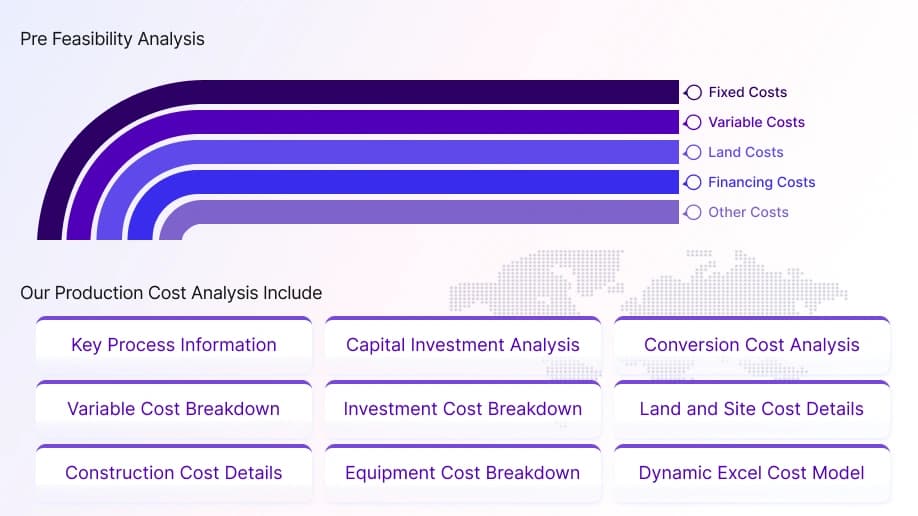
The report provides a detailed analysis essential for establishing an Epichlorohydrin production plant. It encompasses all critical aspects necessary for Epichlorohydrin production, including the cost of Epichlorohydrin production, Epichlorohydrin plant cost, Epichlorohydrin production costs, and the overall Epichlorohydrin production plant cost. Additionally, the study covers specific expenditures associated with setting up and operating an Epichlorohydrin production plant. These encompass production processes, raw material requirements, utility requirements, infrastructure needs, machinery and technology requirements, manpower requirements, packaging requirements, transportation requirements, and more.
Epichlorohydrin is an organochlorine compound used in the production of epoxy resins, which find applications in coatings, adhesives, composites, and synthetic glycerin. It is also employed in the manufacture of elastomers, dyestuffs, cross-linked food starch, glycidyl ethers, plasticizers, surfactants, lubricants, adhesives, pharmaceutical products, and oil emulsifiers. Additionally, it acts as a stabilizer for chlorine-containing compounds like pesticide formulations, rubber, and solvents and as a solvent for cellulose, resins, gums, esters, paints, and lacquers. In the paper and drug industries, it can be used as an insect fumigant. Moreover, Epichlorohydrin is a precursor to glycidyl nitrate, an energetic binder used in explosive and propellant compositions.
The market for Epichlorohydrin is driven by the rising demand for epoxy resins across various industries, including construction, automotive, and electronics. Its utilization to manufacture coatings and plastic components amplifies its demand in the automotive industry. Its usage as a solvent for cellulose, resins, gums, esters, paints, and lacquers fuels its market in the chemical industry. Its utilization in the manufacture of various items such as elastomers, dyestuffs, cross-linked food starch, glycidyl ethers, plasticizers, surfactants, lubricants, adhesives, pharmaceutical products, and oil emulsifiers boosts its demand even more.
Overall, industrial Epichlorohydrin procurement is influenced by its various end-uses, its application in several industries such as construction, automotive, electronics, chemical, plastics, and pharmaceutical industries, the availability of its raw materials (propylene and glycerol), the cost of its raw materials, the rising demand for epoxy resins, and environmental concerns.
Raw Material for Epichlorohydrin Production
According to the Epichlorohydrin production plant project report, the key raw materials used in the production of Epichlorohydrin include propylene; glycerol.
Production Process of Epichlorohydrin
The extensive Epichlorohydrin production cost report consists of the following major industrial production processes:
- Production from propylene: The production process of Epichlorohydrin involves the chlorination of propylene to form allyl chloride. The next step is the chlorohydrination of allyl chloride yields a mixture of dichloropropanols. The final step involves the alkaline dehydrochlorination of the dichloropropanol isomers in the presence of catalysts such as sodium hydroxide or calcium hydroxide, followed by further purification to produce Epichlorohydrin.
- Production from glycerol: The production process of Epichlorohydrin involves the hydrochlorination of glycerol with HCl to form dichlorohydrin in the presence of carboxylic acid as the catalyst. Dichlorohydrin is further reacted with sodium hydroxide and further purification to produce Epichlorohydrin.
Epichlorohydrin (ECH), with the molecular formula C3H5ClO, is an organochlorine compound and an epoxide that has a functional relation to 1,2-epoxypropane. The chemical is a very volatile and flammable chlorinated cyclic ether that has an irritating, chloroform-like odor that produces toxic hydrochloric acid fumes. It appears to be clear, colorless liquid, which can irritate the skin, eyes, and respiratory tract. It's a highly reactive organic compound that will polymerize upon treatment with acid or a strong base. It is sparingly soluble in water but miscible with most polar organic solvents. It has a molecular weight of 92.53 g/mol and a density of 1.1812 g/cm3. It has respective flash, boiling, and freezing points of 88°F (31°C), 242F (117°0), -54°F (-47.8°C).