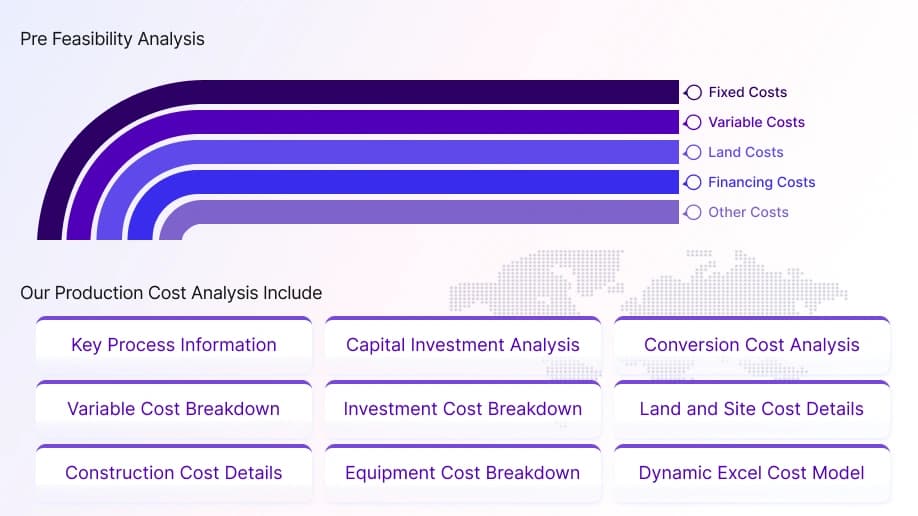
The report provides a detailed analysis essential for establishing an Ethyl Linoleate production plant. It encompasses all critical aspects necessary for Ethyl Linoleate production, including the cost of Ethyl Linoleate production, Ethyl Linoleate plant cost, Ethyl Linoleate production costs, and the overall Ethyl Linoleate production plant cost. Additionally, the study covers specific expenditures associated with setting up and operating an Ethyl Linoleate production plant. These encompass production processes, raw material requirements, utility requirements, infrastructure needs, machinery and technology requirements, manpower requirements, packaging requirements, transportation requirements, and more.
Ethyl Linoleate is a versatile chemical that has been researched and developed to be used in the pharmaceutical and cosmetic industries. It is also used in products for skin and hair due to its antibacterial, anti-inflammatory, and anti-acne properties, which help to support skin hydration and nourishment and boost lipid metabolism. Within the pharmaceutical industry, Ethyl Linoleate is utilized in formulations that address diseases associated with elevated plasma cholesterol and liver health because of its possible anti-inflammatory properties. It also inhibits melanogenesis, which is advantageous for lowering hyperpigmentation in cosmetic goods. Due to its high percentage of essential fatty acids, it can also be incorporated into dietary supplements, which are used to improve general health.
The market for Ethyl Linoleate is driven by its usage in various industries. The presence of properties such as antibacterial, anti-inflammatory, and anti-acne make this ingredient useful in cosmetics that treat skin issues; this ensures its high demand in the self-care and cosmetic industries. Furthermore, it effectively treats conditions associated with plasma cholesterol and liver and, therefore, has potential in formulation for the management of chronic liver-related diseases, putting it in high demand in the pharmaceutical and medical industries.
Also, the compound can be added to the dietary supplements hence enhancing general health and contributing to its market growth. Overall, industrial Ethyl Linoleate procurement is influenced by its application in the self-care and cosmetic industry, its utilization in the pharmaceutical and medical industries, and its employment in dietary supplements.
Raw Material for Ethyl Linoleate Production
According to the Ethyl Linoleate production plant project report, the key raw material used in the production of Ethyl Linoleate includes linoleic acid.
Production Process of Ethyl Linoleate
The extensive Ethyl Linoleate production cost report consists of the following major industrial production process:
- Production from linoleic acid: The production process of Ethyl Linoleate involves the esterification reaction of linoleic acid with ethanol in the presence of sulphuric acid as the catalyst under reflux to produce Ethyl Linoleate as the final product.
Ethyl Linoleate is a colorless to pale yellow liquid having the molecular formula C20H36O2 and a molecular weight of 308.5 g/mol. It has a boiling point of 250°C and a flash point of 100°C. It has a density of around 0.895 g/cm³ at 20°C. It is hygroscopic and nonpolar in nature, so it does not dissolve in water but dissolves in organic solvents like ethanol, ether, and chloroform. It is stable in dark solutions and at room temperature but is subjected to degradation under exposure to light, heat, or air for longer times. Ethyl Linoleate has double bonds which make this compound to be susceptible to polymerization and oxidation reactions. Its chemical reactivity is improved due to the presence of functional groups from unsaturated and ester fatty acids that allow the substance to participate in the chemical processes of transesterification as well as hydrolysis.