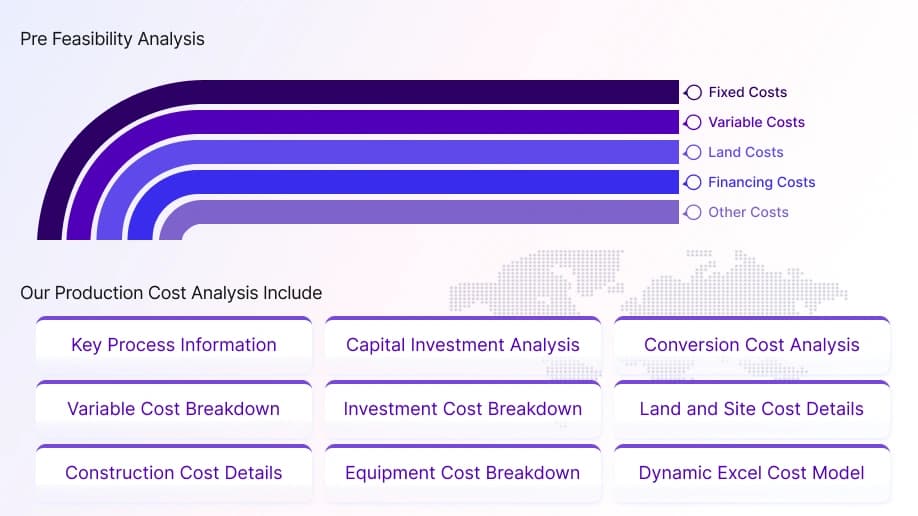
The report provides a detailed analysis essential for establishing a Furosemide production plant. It encompasses all critical aspects necessary for Furosemide production, including the cost of Furosemide production, Furosemide plant cost, Furosemide production costs, and the overall Furosemide production plant cost. Additionally, the study covers specific expenditures associated with setting up and operating a Furosemide production plant. These encompass production processes, raw material requirements, utility requirements, infrastructure needs, machinery and technology requirements, manpower requirements, packaging requirements, transportation requirements, and more.
Furosemide is a medication used to treat many symptoms associated with various medical conditions. It works by blocking a specific transporter in the kidneys that stops the reabsorption of sodium and chloride, causing the body to get rid of excess water and lower blood pressure. It is utilized in managing symptoms of congestive heart failure, like fluid retention and edema. It is employed in treating ascites caused because of liver cirrhosis by assisting fluid removal, giving relief to discomfort in abdominal organs. Furosemide is used in treating nephrotic syndrome-associated fluid retention and helps in reducing edema and hypertension in kidney disorders. It is an effective alternative for treating hypertension in those patients who are not responsive to other medications. It is employed in reducing respiratory discomfort in pulmonary edema patients.
The market for Furosemide is driven by several factors. Its utilization in treating symptoms like fluid retention and blood pressure associated with congestive heart failure contributes largely to its demand. Its effectiveness in liver cirrhosis and treating nephrotic syndrome makes it a sought-after product in medical settings. Its use as an alternative for treating hypertension in those unresponsive to other medications further contributes to its demand. Its market is also affected by variability in the pricing of its formulations and compliance with regulations regarding its diuretic use. Overall, industrial furosemide procurement is influenced by its usage for treating fluid retention, hypertension, and edema associated with various medical conditions, along with cost considerations, regulatory compliance, formulation preferences, market trends, and updated clinical guidelines.
Raw Material for Furosemide Production
According to the Furosemide production plant project report, the key raw materials used in the production of Furosemide include 4,6-dichlorobenzoic acid-3-sulfonylchloride-Chlorine-Ammonia-Sulphur Dioxide.
Production Process of Furosemide
The comprehensive Furosemide production cost report consists of the following major industrial production process:
- From 4,6-Dichlorobenzoic acid-3-Sulfonylchloride, Chlorine, Ammonia, and Sulphur Dioxide: The industrial production of Furosemide is a multi-step process. First, 4,6-dichlorobenzoic acid-3-sulfonylchloride is chlorinated using chlorine gas, forming an intermediate having chlorine atoms attached to it. After that, sulfonation of this intermediate takes place in the presence of sulfur dioxide, adding sulfonic acid groups to it. Finally, amination introduces the amine group to the intermediate-forming Furosemide. The final product is purified and tested to obtain pure Furosemide.
Furosemide is a white to yellow crystalline solid. Its molecular formula is C12H11ClN2O5S, and it has a molecular weight of 330.74 g/mol. Its melting point is around 206°C. It is faintly soluble in water but shows good solubility in dimethylformamide, acetone, and methanol. Its dissociation constant value is around 3.9 making it acidic nature. It contains a furan and a phenyl ring. It is sensitive to light leading to its discoloration. It precipitates when mixed with calcium gluconate and ascorbic acid. These physical and chemical properties contribute to its effectiveness in treating various disorders.