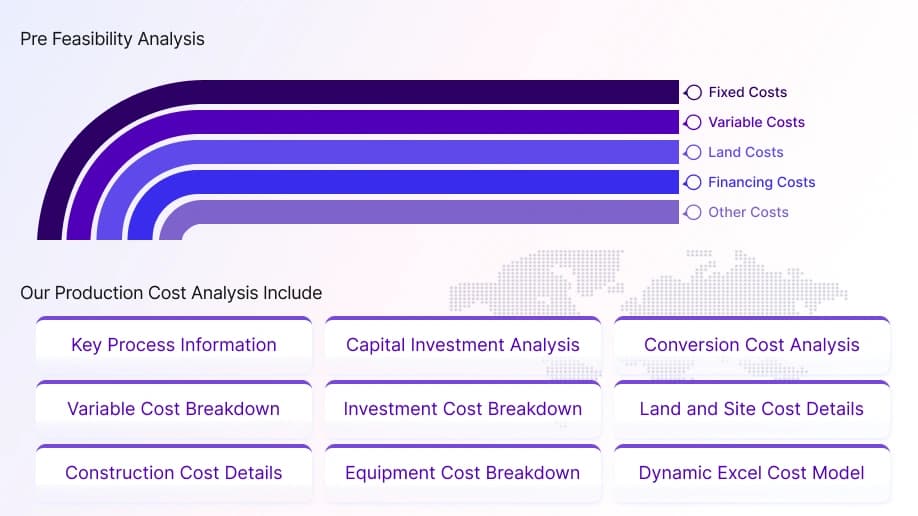
The report provides a detailed analysis essential for establishing a Glycerol Monostearate production plant. It encompasses all critical aspects necessary for Glycerol Monostearate production, including the cost of Glycerol Monostearate production, Glycerol Monostearate plant cost, Glycerol Monostearate production costs, and the overall Glycerol Monostearate production plant cost. Additionally, the study covers specific expenditures associated with setting up and operating a Glycerol Monostearate production plant. These encompass production processes, raw material requirements, utility requirements, infrastructure needs, machinery and technology requirements, manpower requirements, packaging requirements, transportation requirements, and more.
Glycerol Monostearate is an organic molecule used as an emulsifier that helps in the blending of oil and water in processed foods. It is available as a flaky white powder, which finds its use in various industries. Glycerol Monostearate helps to blend oil and water-based ingredients in food and prevents their separation, improving the texture, stability, and mouthfeel of the food, preventing ice crystal formation in ice creams, contributing to their smooth texture, and acting as a thickening agent, giving creamy consistency to items like mayonnaise. Tablets coated with Glycerol Monostearate deliver the drug uniformly. Glycerol Monostearate when used in makeup or skin care products, it improves the feel and texture of the products.
The market of Glycerol Monostearate is driven by a wide range of factors. With the increasing population, the demand for processed food is showing an upward trend, and Glycerol Monostearate is a safe additive to food, which is approved by the FDA, helps in extending the shelf life and enhancing the taste of food, and simultaneously promotes a healthy lifestyle.
As the concept of self-care has come to light, people are becoming interested in skincare and skincare-enhanced makeup products, further boosting its demand. Furthermore, several factors influence industrial Glycerol Monostearate procurement, such as the cost and availability of raw materials, Glycerol Monostearate market prices, quality standards, distribution (including trading and shipping), logistics, regulatory compliance, regulations, safety standards, etc.
Raw Material for Glycerol Monostearate Production
According to the Glycerol Monostearate production plant project report, the major raw materials for Glycerol Monostearate production include glycerine and stearic acid.
Manufacturing Process of Glycerol Monostearate
The extensive Glycerol Monostearate production cost report consists of the following industrial production process:
- Production from glycerine and stearic acid: The production process of Glycerol Monostearate an esterification reaction. Chemical catalyzed process (involves the use of a catalyst) and autocatalytic process (without catalyst) are industrially used. Raw materials that are glycerine and stearic acid and transferred to a reactor to which a catalyst is added. This mixture is heated between 180°C and 220°C, which drives the esterification reaction, and water is obtained as a byproduct. Distillation of the obtained product is done to remove di and triglycerides, which are also produced as byproducts. The final product goes for quality checks and downstream processing.
Glycerol Monostearate is solid at room temperature and appears as a white-colored, flaky powder which incapable of dissolving in water but can dissolve in organic compounds like ethanol. Glycerol Monostearate, with the chemical formula C21H42O4, is a fatty acid molecule composed of glycerine and stearic acid held together with an ester bond. It has no odor, a slightly sweet taste, a melting point in the range of 58°C to 65°C, and a density of 0.97 g/cm³.