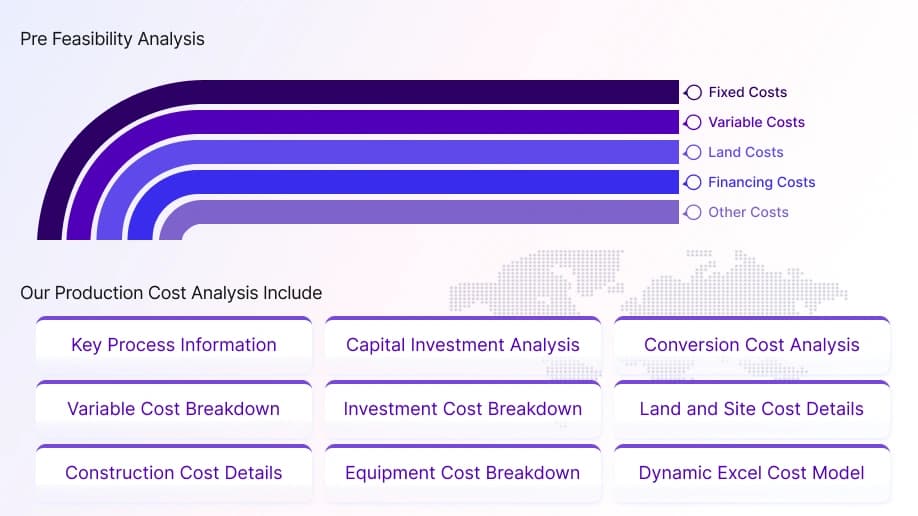
The report provides a detailed analysis essential for establishing a hirudin production plant. It encompasses all critical aspects necessary for hirudin production, including the cost of hirudin production, hirudin plant cost, hirudin production costs, and the overall hirudin production plant cost. Additionally, the study covers specific expenditures associated with setting up and operating a hirudin production plant.
These encompass production processes, raw material requirements, utility requirements, infrastructure needs, machinery and technology requirements, manpower requirements, packaging requirements, transportation requirements, and more.
Hirudin is a peptide that occurs naturally in the salivary glands of medicinal leeches (Hirudo medicinalis) and has a blood anticoagulant property. It is used to prevent blood clots and treat conditions such as deep vein thrombosis, acute coronary artery disease, etc. It is also used for postoperative prophylaxis and cardiovascular surgery. Moreover, it is also utilized in research studies as a model for developing new anticoagulant drugs. Additionally, it is sometimes used in the manufacture of certain cosmetic formulations due to its anti-aging properties.
The market for hirudin is majorly driven by its applications in the medical, pharmaceutical, and healthcare industries as a treatment for various diseases, which boosts its market growth. Moreover, its employment in cardiovascular surgery further amplifies its demand in the medical industry.
Its application in research and therapeutic use to understand the mechanism and potency of new drugs remarkably propels its demand in the biotechnology and pharmaceutical research industries. Additionally, its usage as a component in production certain high-end cosmetic products that positively promotes its demand in the cosmetics industry.
Furthermore, several factors influence industrial hirudin procurement, such as the source and purity, cost and pricing, compliance with pharmaceutical regulations, quality standards, technological advancements, environmental considerations, sustainability practices, distribution (including trading and shipping), logistics, safety standards, etc.
Raw Material for Hirudin Production
According to the Hirudin production plant project report, the major raw materials for Hirudin production include Whole leeches-Saccharomyces cerevisiae.
Production Process of Hirudin
The extensive Hirudin production cost report consists of the following industrial production process:
- Production from Whole leeches: This method of producing hirudin involves the preparation of crude hirudin by various steps, which include aqueous extraction, adsorption, and elution on/from bentonite and, subsequently, some other fractionation steps. Further, crude hirudin is purified by chromatography on Ecteola-cellulose, followed by rechromatography on CM-Sephadex C-25 and Sephadex G 75. After rechromatography, the homogeneity of the resulting product is tested by group analysis and ultracentrifugation.
- Production via Recombinant DNA technology: This process involves advanced peptide isolation and genetic engineering, using recombinant DNA technology to produce recombinant hirudins (r-hirudins) from Saccharomyces cerevisiae.
Hirudin is a naturally occurring peptide that is a single chain polypeptide made up of 65 amino acid residues. It is a small compound that is a direct thrombin inhibitor. It appears as a white to off-white powder in its pure form and is soluble in water.
The molecular formula of the compound is C287H440N80O113S7 and its molecular weight is 7000 Daltons. Moreover, its structure is stabilized by three intramolecular disulfide bridges. It has a thrombolytic activity as it prevents formation of clots or thrombi. It is isolated and purified before using as a medicine.