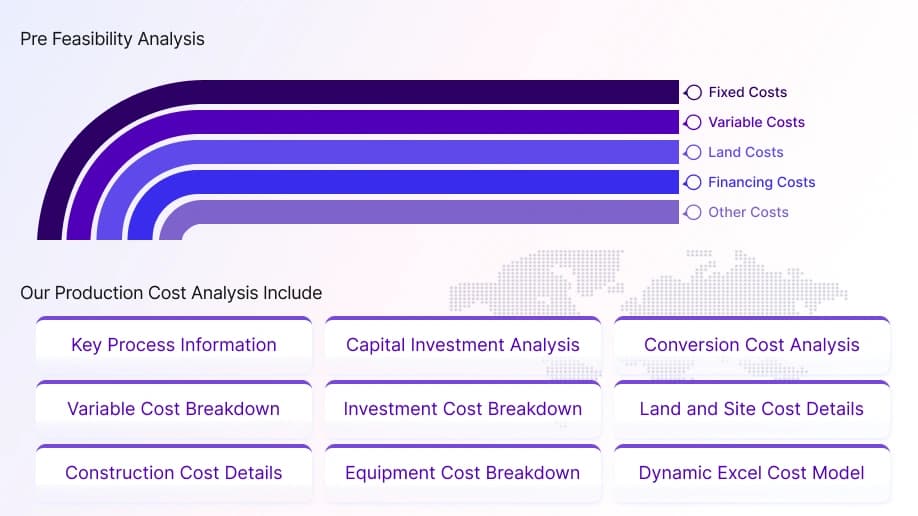
The report provides a detailed analysis essential for establishing a hydrogen production plant. It encompasses all critical aspects necessary for hydrogen production, including the cost of hydrogen production, hydrogen plant cost, hydrogen production costs, and the overall hydrogen production plant cost. Additionally, the study covers specific expenditures associated with setting up and operating a hydrogen production plant. These encompass production processes, raw material requirements, utility requirements, infrastructure needs, machinery and technology requirements, manpower requirements, packaging requirements, transportation requirements, and more.
Hydrogen is a clean energy source, majorly associated with fuel, chemical, plastic, healthcare, and agrochemical industries. Hydrogen is extensively employed as a cleaner substitute for fuel used in cars and buses. It serves as a raw material used to create ammonia for agricultural and chemical operations. It is also used to produce plastics and pharmaceutical products. In addition, it is used to get rid of sulfur from fuels in the oil-refining process. Additionally, hydrogen is used in the production of glass products, including flat glass sheets. It is employed in silicon chip production as a flushing gas, which is further installed in electronic gadgets.
The market for hydrogen is driven by its demand observed in the energy, chemical, pharmaceutical, plastic, electronic, agrochemical, and glass industries. Its usage in the production of energy in the form of electricity or power to run transportation and machinery as an alternative to methane amplifies its demand in the energy sector. Moreover, its use in the synthesis of its derivatives, including ammonia that, is further used in agrochemical and chemical industries, directly strengthens its demand in the market. Similarly, its wide-scale application in glass making, chemical production, plastic production, and agrochemical preparation altogether boosts its demand in the global market.
The increase or decrease in its demand as a clean energy source or as an element in chemical production plays a major role and governs the industrial hydrogen procurement in the world. Its procurement is directly determined by various other factors, including its prices, logistics, supply, governmental and trade policies, etc. Hence, these factors, including its demand in the chemical, energy, pharmaceutical, and agrochemical industries, along with its distribution and market prices, are essential to determine its procurement.
Raw Material for Hydrogen Production
According to the hydrogen production plant project report, the key raw material for hydrogen production includes natural gas; water.
Production Process of Hydrogen
The extensive hydrogen production cost report consists of the major industrial production process:
- By Electrolysis Process: Hydrogen is produced as a product of electrolysis of water.
- From Natural Gas: The production process of hydrogen is carried by processing methane obtained from natural gas, using steam.
- By Partial Oxidation: The production of hydrogen comprises the partial oxidation of methane obtained from natural gas. The reaction is carried out in the presence of oxygen to obtain hydrogen at the end.
Hydrogen (H) is a colorless, tasteless, and odorless gas with the lowest density compared to all gases. It is abundantly present in nature (75% of the universe's mass) in compound form with other elements in gases, liquids, and solids. It is a cleaner substitute for methane, also called natural gas. It can be produced via various resources, including nuclear power, natural gas, biogas, and renewable energy, such as wind and solar.
Hydrogen has the atomic number 1 with a melting and boiling point of −259.16°C, −252.879°C. It has a density of 0.000082 g cm−3. It is highly flammable and burns with oxygen to form water and H2O. It is available in water as well as in all molecules of living organisms. It is also a non-toxic and safe gas to produce, transport, and store in large amounts.