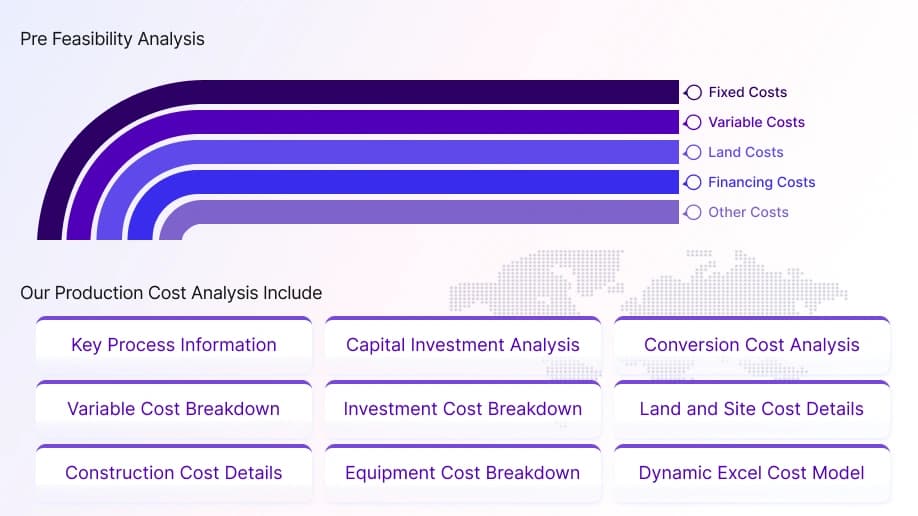
The report provides a detailed analysis essential for establishing an Iridium Chloride production plant. It encompasses all critical aspects necessary for Iridium Chloride production, including the cost of Iridium Chloride production, Iridium Chloride plant cost, Iridium Chloride production costs, and the overall Iridium Chloride production plant cost. Additionally, the study covers specific expenditures associated with setting up and operating an Iridium Chloride production plant. These encompass production processes, raw material requirements, utility requirements, infrastructure needs, machinery and technology requirements, manpower requirements, packaging requirements, transportation requirements, and more.
Iridium Chloride is an inorganic acid compound that finds applications in various industries. It is extensively utilized as a precursor in the manufacture of various IR(III)-based complex compounds that have further application as a triplet emitter in organic light-emitting diodes. Moreover, the compound is widely used as a raw material for the synthesis of various iridium compounds and iridium-based catalysts (hydrogenation catalysts and polymerization catalysts). Additionally, it also finds broad application in the preparation of various organometallic complexes due to its good stability.
The market of Iridium Chloride is largely led by its application as a precursor in the production of various iridium compounds and iridium catalysts, which significantly promotes its demand in the chemical production industry. Moreover, its employment in the synthesis of various organometallic complex compounds that are further used in the production of various pharmaceuticals and other drugs remarkably accelerates its demand in the medicinal chemistry and pharmaceutical industries. Furthermore, several factors influence industrial Iridium chloride procurement, such as the availability of raw materials (metal iridium powder, etc.), cost and pricing, regulatory compliance, quality standards, technological advancements, environmental considerations, sustainability practices, distribution (including trading and shipping), logistics, safety standards, etc.
Raw Material for Iridium Chloride Production
According to the Iridium Chloride production plant project report, the major raw materials for Iridium Chloride production include Metal Iridium Powder-Chlorine (Cl2).
Production Process of Iridium Chloride
The extensive Iridium Chloride production cost report consists of the following industrial production process:
- Production from Metal Iridium Powder: This method of production is initiated by placing the metal iridium powder in the porcelain boat and then into the combustion tube, whose one end is equipped with a ground joint and the other end serves as the gas inlet end. Further, chlorine (Cl2), which contains a small amount of carbon monoxide (CO) and no oxygen, is poured into the tube, followed by heating the combustion tube to 600°C by using a blowtorch flame and irradiating it with direct sunlight or with strong light from a magnesium strip, which results in the formation of anhydrous iridium chloride (IrCl3) after 15 minutes of chlorination.
Iridium Chloride appears as a brown-black solid that is soluble in water, and it generally exists in the form of hydrate. Moreover, its molecular formula is Cl3Ir, and its molar mass is 298.57 g/mol. The IUPAC name of the compound is trichloroiridium. The density of the compound is 5.30g/cm3. Additionally, the compound gets easily dissolved in water and alcohol, and is sensitive to moisture and heat. The melting point of the compound is 763 degrees Celsius. The compound is also known as Indium trichloride or Iridium(III)chloride. It serves as a precursor in the manufacture of various other iridium compounds.