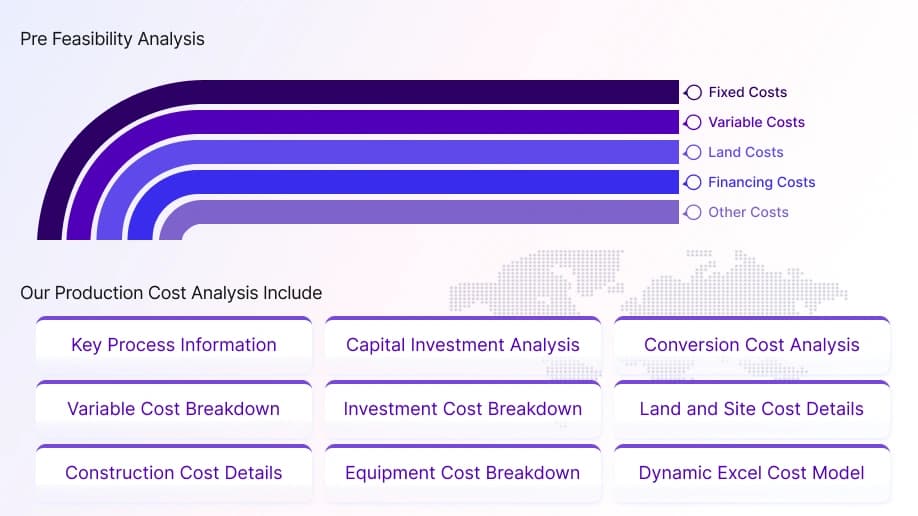
The report provides a detailed analysis essential for establishing an iron production plant. It encompasses all critical aspects necessary for iron production, including the cost of iron production, iron plant cost, iron production costs, and the overall iron production plant cost. Additionally, the study covers specific expenditures associated with setting up and operating an iron production plant. These encompass production processes, raw material requirements, utility requirements, infrastructure needs, machinery and technology requirements, manpower requirements, packaging requirements, transportation requirements, and more.
Iron is a metal element produced by the processing of haematite ore. It is majorly associated with the metal industry to produce alloys on a large scale. Iron is widely employed in steel production and also used in civil engineering, such as reinforced concrete, girders etc. It serves as a metal component along with other metal varieties such as nickel, chromium, vanadium, tungsten, and manganese to produce alloys in the metal industry. Similarly, it also has applications in the construction, chemical, and automobile industries.
It is employed for building bridges, bicycle chains, electricity pylons, cutting tools, rifle barrels, etc. It serves as a catalyst in the Haber process for ammonia production. It is also used in the Fischer–Tropsch process to convert syngas (hydrogen and carbon monoxide) into liquid fuels. It can be used for making magnets. Moreover, cast iron with 3–5% carbon is used for making valves, pipes, and pumps. The metal is used for making a variety of metal products, including food containers, automobiles, tools such as screwdrivers, and machinery, including washing machines, etc.
The wide-scale applications of iron metal across metal, construction, automobile, and chemical industries add up to the factors that propel its demand in the global market. Its primary application in steel production, which is then used for construction and automobile operations, boosts the demand for iron. Similarly, its usage in tools, alloys, and machinery directly impacts its market growth. Industrial iron procurement is largely governed by the rise and fall in demand across various regions.
Its demand, primarily in the metal industry for steel production, amplifies its market growth and influences its procurement across various regions. Therefore, variations in its demand, along with other prominent factors such as its availability (covering countries like Australia, China, India, etc.), supply, production cost, market prices, distribution, etc., altogether influence its procurement around the world.
Raw Material for Iron Production
According to the iron production plant project report, the key raw material for iron production includes haematite mineral ore (for iron metal).
Production Process of Iron
The extensive iron production cost report consists of the major industrial production process:
- By Extraction: Production of iron metal is initiated by mining haematite mineral ore from the earth's crust. The ore is then processed through crushing, extraction and sintering in a blast furnace to produce iron at the end.
Iron (Fe) is a chemical element that is classified as a metal belonging to the periodic table's Group 8 (VIII b). The metal is abundantly present in the planet's crust, and on a commercial scale, iron is made in a blast furnace via heating haematite or magnetite with coke (carbon) and limestone (calcium carbonate), resulting in the formation of pig iron that is further used to make steel.
Iron is the most used and least expensive metal in the world. It has the atomic number 26 and an atomic weight of 55.847. Its respective melting and boiling point are 1,538 °C (2,800 °F) and 3,000 °C (5,432 °F). The atomic mass of iron is 55.85 g.mol -1. Its density is (g cm−3)7.8 g.cm-3 at 20°C. It has properties like being ductile, malleable, lustrous, and silver-grey in colour. It can rust in damp air, easily dissolves in dilute acids.