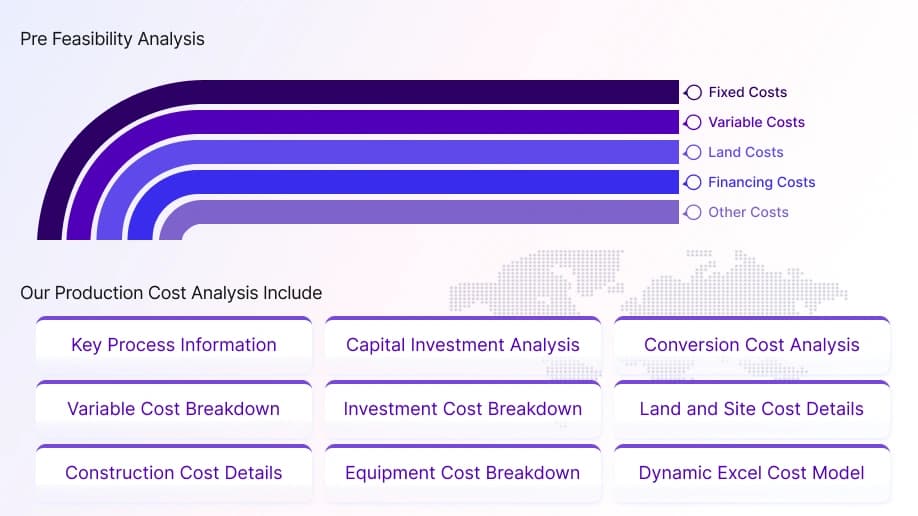
The report provides a detailed analysis essential for establishing a Juglone production plant. It encompasses all critical aspects necessary for Juglone production, including the cost of Juglone production, Juglone plant cost, Juglone production costs, and the overall Juglone production plant cost. Additionally, the study covers specific expenditures associated with setting up and operating a Juglone production plant. These encompass production processes, raw material requirements, utility requirements, infrastructure needs, machinery and technology requirements, manpower requirements, packaging requirements, transportation requirements, and more.
Juglone is a component that is generally found in all parts of the walnut trees. Form of naphthoquinone that is commonly found in nature. Moreover, the compound is often utilized as a medicine for the treatment of various infections due to its anti-fungal and anti-microbial properties. It also finds its application as a natural dye that is further used for coloring or dyeing fabrics and other materials. It is also used in the manufacture of herbicides due to its effective allelopathic properties. Additionally, it is also employed as a coloring agent in the production of various food and cosmetics products, such as hair dye.
The market for Juglone is driven by its usage as a natural dye in the textile industry for dyeing fabrics, which significantly boosts its market growth. Moreover, its application as a natural coloring agent, often utilized to impart colors in various food products, hair dyes, etc, further enhances its demand in the food & beverage, cosmetics, and personal care industries. Its utilization in the production of herbicides to control the growth of weeds effectively promotes its demand in the agrochemical industry.
Additionally, its employment as an anthelmintic (a group of antiparasitic drugs) for the treatment of various parasitic infections remarkably accelerates its demand in the medical and pharmaceutical industries. Furthermore, several factors influence industrial Juglone procurement, such as the availability of raw materials (walnut green husk, etc.), cost and pricing, regulatory compliance, quality standards, technological advancements, environmental considerations, sustainability practices, distribution (including trading and shipping), logistics, safety standards, etc.
Raw Material for Juglone Production
According to the Juglone production plant project report, the major raw materials for Juglone production includes Walnut Green Husk (Juglans regia L.).
Manufacturing Process of Juglone
The extensive Juglone production cost report consists of the following industrial production process:
- Production via Supercritical Fluid Extraction (SFE): This method of production involves the extraction of juglone by using the technique of Supercritical carbon dioxide (SC−CO2), which proves to be an efficient, non-toxic extraction technique for extracting the natural dyes with the help of a supercritical fluid as the solvent. The process uses carbon dioxide as the supercritical fluid to produce a solvent-free extract at low critical temperature (31 degrees Celcius) and pressure. In this method, juglone is extracted through supercritical CO2 extraction from the walnut (Juglans regia L.) green husk (WGH) by using ethanol as the co-solvent at the optimum conditions of 150bar, 35, and 375μm.
Juglone (5-hydroxy-1,4-naphtalenedione) is a chemical compound that appears yellow in its pure form and turns orange, red, or, mainly, brown when it is exposed to oxygen. The compound is a naphthoquinone that has herbicidal and anthelmintic applications. It generally exists as a yellow-brown crystal or powder with a molar mass of 174.15 g/mol. Moreover, the molecular formula of the compound is C10H6O3. The IUPAC name of the compound is 5-hydroxynaphthalene-1,4-dione. Additionally, its melting point is 155°C, and water solubility is 2–5 g/L. The compound is mainly used as a dye.