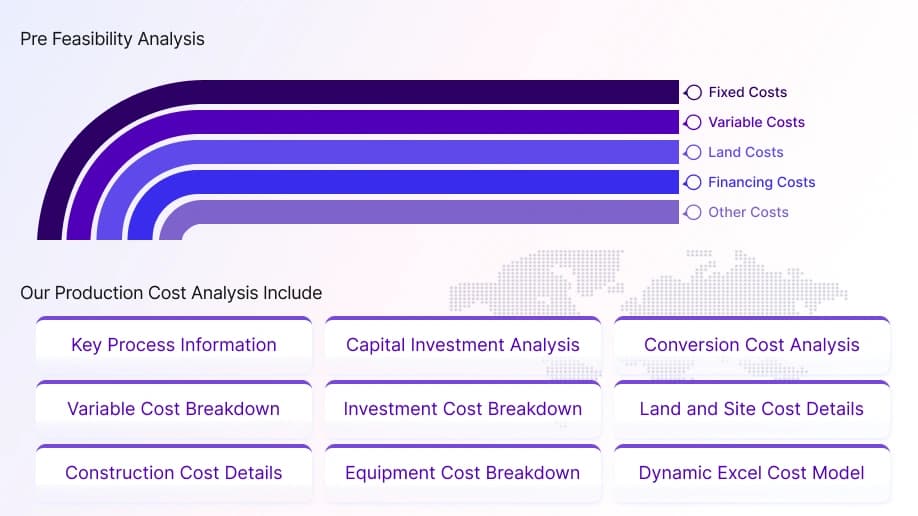
The report provides a detailed analysis essential for establishing a kerosene production plant. It encompasses all critical aspects necessary for kerosene production, including the cost of kerosene production, kerosene plant cost, kerosene production costs, and the overall kerosene production plant cost. Additionally, the study covers specific expenditures associated with setting up and operating a kerosene production plant. These encompass production processes, raw material requirements, utility requirements, infrastructure needs, machinery and technology requirements, manpower requirements, packaging requirements, transportation requirements, and more.
Kerosene is a fuel variety that is majorly associated with energy generation and powering automobile industries. It is a combustible fluid employed for burning lamps and furnaces or domestic heaters, as a fuel (being a major component of aviation fuel, over 60% of the fuel), and also in jet engines.
It serves as a solvent, and it is used for insecticides and greases. In addition to that, it finds use as an oil in central heating systems and also as a cleaning agent. It is widely used for energy generation. It works like a great substitute for solid fuels, biomass, and coal and works great in places with limited or no access to electricity.
The market for kerosene is largely driven by its demand in the petrochemical and energy sectors. Its utilization as a common combustible fluid for household and commercial operations boosts its demand in the global market. Its applications in energy generation and power machinery for mechanical operations amplify its demand in the energy and power industries.
Industrial kerosene procurement is majorly dependent upon the demand observed in the petrochemical and energy sectors. Other prominent factors, including its market prices, production, and processing cost, and supply, directly govern its procurement. Hence, shifts in its demand across the energy and petrochemical industries, along with its availability have a major impact on its procurement across the borders.
Raw Material for Kerosene Production
According to the kerosene production plant project report, the key raw material for kerosene production includes crude oil.
Production Process of Kerosene
The extensive kerosene production cost report consists of the major industrial production process:
- By Fractional Distillation: The production process of kerosene is initiated by distillation of crude oil. The crude oil undergoes distillation at a high temperature and is then filtered to obtain kerosene as the end product.
Kerosene is a hydrocarbon liquid derived from petroleum that is mainly used as a fuel. It’s produced in a distillation tower where crude oil is distilled in the refining process. It looks like a pale yellow or colourless liquid. It's a mixture of hydrocarbons typically consisting of around 10 different hydrocarbons, each consisting of 10 to 16 carbon atoms per molecule. Its chemical composition is relatively complex, including naphthenes (40.9%), a mixture of paraffin (55.2%), and aromatic hydrocarbons (3.9%).
It is less volatile than gasoline, with a flash point of 38 °C (100 °F) or higher, making it a safer fuel to store and handle. It is among the so-called middle distillates of crude oil with a boiling point between 150 and 300 °C. It has many advantages, like safety with a lower risk of carbon monoxide poisoning; being less expensive than gas; more environmentally friendly; and having a long shelf life since it's non-corrosive and stored in a suitable tank which is stored under dry and controlled conditions.