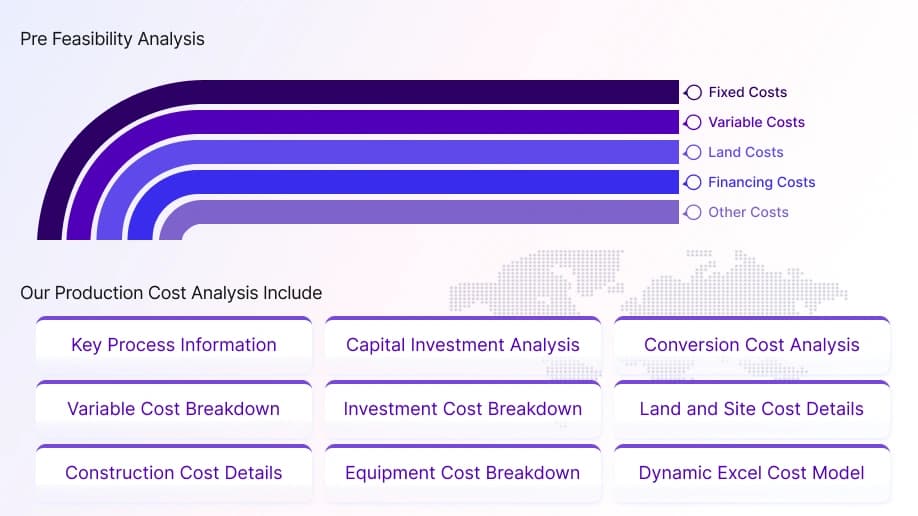
The report provides a detailed analysis essential for establishing a L-Ornithine production plant. It encompasses all critical aspects necessary for L-Ornithine production, including the cost of L-Ornithine production, L-Ornithine plant cost, L-Ornithine production costs, and the overall L-Ornithine production plant cost. Additionally, the study covers specific expenditures associated with setting up and operating a L-Ornithine production plant. These encompass production processes, raw material requirements, utility requirements, infrastructure needs, machinery and technology requirements, manpower requirements, packaging requirements, transportation requirements, and more.
L-ornithine is an L-configured non-protein amino acid that is of great industrial importance. It is widely utilized in dietary supplements to promote the release of growth hormones, enhance athletic performance, and boost overall energy levels. Moreover, it is also used in formulations that aim at promoting liver function, detoxifying the body, and improving liver health. Additionally, it also finds applications as a skin conditioning agent in the manufacture of skincare and cosmetic formulations.
The market for L-ornithine is majorly driven by its broad usage in the medical and pharmaceutical industries as a hepatoprotective agent in the manufacture of various liver-supporting preparations, which significantly boosts its market growth. Moreover, its application as a nutrient supplement to enhance athletic performance and boost the immune system further accentuates its demand in the healthcare and wellness industries.
Additionally, its employment in the manufacture of skin moisturizing products, due to its collagen-boosting properties, remarkably propels its demand in the cosmetics industry. Furthermore, several factors influence industrial L-Ornithine procurement, such as the source and its purity, cost, and pricing, compliance with medical and pharmaceutical regulations, quality standards, technological advancements, environmental considerations, sustainability practices, distribution (including trading and shipping), logistics, safety standards, etc.
Raw Material for L-Ornithine Production
According to the L-Ornithine production plant project report, the major raw material for L-Ornithine production includes Corynebacterium glutamicum.
Production Process of L-Ornithine
The extensive L-Ornithine production cost report consists of the following industrial production process:
- Production via Genetic Engineering Modulations: This method of production involves the use of genetic modification strategies by using citrulline or arginine auxotrophic microorganisms such as Corynebacterium glutamicum to produce L-ornithine as the product in a fed-batch cultivation process. In this method, engineered strains of Corynebacterium glutamicum are subjected to microbial fermentation in a fed-batch cultivation process by using glucose and sucrose to produce L-ornithine by manipulating the fructose metabolic pathway in the bacterium strain.
L-ornithine is recognized as the optically active form of ornithine that is produced during the Urea cycle. The molecular formula of the compound is C5H12N2O2, and its molecular weight is 132.16 g/mol. Moreover, the melting point of the compound is 140°C and has an isoelectric point of (pH) of 9.71. The compound is soluble in water as well as ethanol. Additionally, the log P value of the compound is -4.22, and its pKa value is 1.94 at 25 degrees Celsius. The compound has a wide range of applications in the fields of medical, cosmetics, and chemical industries.