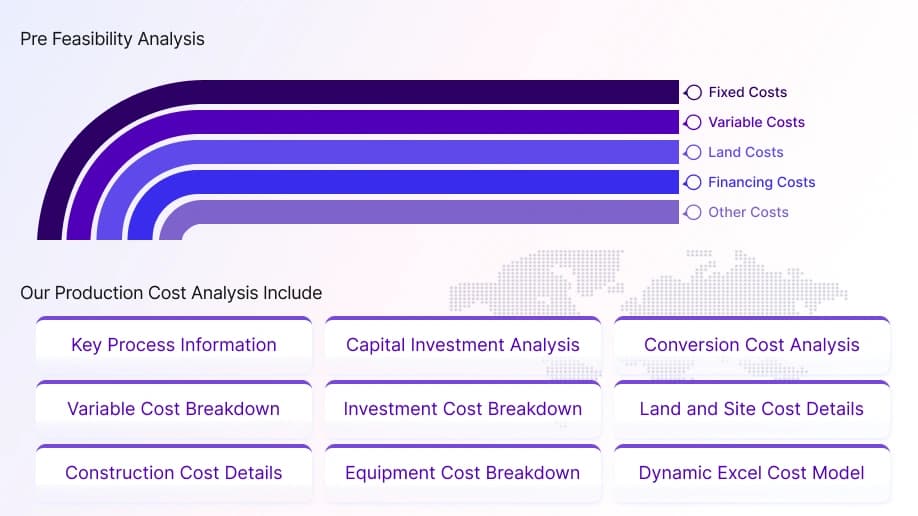
The report provides a detailed analysis essential for establishing a Leuprorelin acetate production plant. It encompasses all critical aspects necessary for Leuprorelin acetate production, including the cost of Leuprorelin acetate production, Leuprorelin acetate plant cost, Leuprorelin acetate production costs, and the overall Leuprorelin acetate production plant cost. Additionally, the study covers specific expenditures associated with setting up and operating a Leuprorelin acetate production plant. These encompass production processes, raw material requirements, utility requirements, infrastructure needs, machinery and technology requirements, manpower requirements, packaging requirements, transportation requirements, and more.
Leuprorelin Acetate is a potent analog of LH-RH that finds broad applications in the medical industry. It is extensively used as an antineoplastic agent for the treatment of prostate cancer. Moreover, it is also utilized for the suppression of gonadal sex hormone production in children with central precocious puberty. Additionally, it also finds its application as a medicine in the treatment of endometriosis and uterine fibroids and as a part of transgender hormone therapy.
The market for Leuprorelin acetate is majorly led by its role as a synthetic nonapeptide analog of gonadotropin-releasing hormone that is used to treat prostate cancer, which significantly promotes its demand in the medical industry. Its utilization as an anti-cancer drug for the treatment of endometriosis and uterine fibroids further accentuates its demand in the pharmaceutical and healthcare industries. Furthermore, several factors influence industrial Leuprorelin acetate procurement, including the availability and cost of production of its raw materials, dicyclohexylcarbodiimide, etc., which is required for its production. Moreover, regulatory compliance, adherence to strict quality standards, technological advancements in production processes, and environmental concerns also play an important role. Additionally, the dynamics of its demand, efficient distribution networks, logistics management, and safety standards, along with supplier relationships, further influence procurement strategies.
Raw Material for Leuprorelin Acetate Production
According to the Leuprorelin Acetate production plant project report, the major raw materials for Leuprorelin Acetate production include Chloromethylated Divinylbenzene-Styrene Copolymer Resin- Dicyclohexylcarbodiimide.
Production Process of Leuprorelin Acetate
The extensive Leuprorelin Acetate production cost report consists of the following industrial production process:
- Production via Boc Strategy: This method of production involves a solid-phase peptide synthesis using the Boc strategy that employs a chloromethylated divinylbenzene-styrene copolymer resin as solid support in a Merrifield synthesizer to produce leuprorelin acetate as the product. The process involves the addition of Boc-protected amino acids, with coupling facilitated by dicyclohexylcarbodiimide. Further, the peptide chain is assembled, followed by deprotection with hydrogen fluoride, and is then subjected to purification methods through chromatography. The purified product is then lyophilized to obtain leuprorelin acetate as the final product.
Leuprorelin Acetate is the acetate salt of a synthetic gonadotropin-releasing hormone. The molecular weight of the compound is 1269.4 g/mol, and its molecular weight is C61H88N16O14. The compound is also known as Leuprolide acetate or Lupron. Moreover, the compound exists in the form of an off-white solid and is stored at -20°C. The melting point of the compound is 150-155°C. Additionally, the compound serves as a hormone anti-cancer drug that finds its huge applications in the medical and pharmaceutical industries.