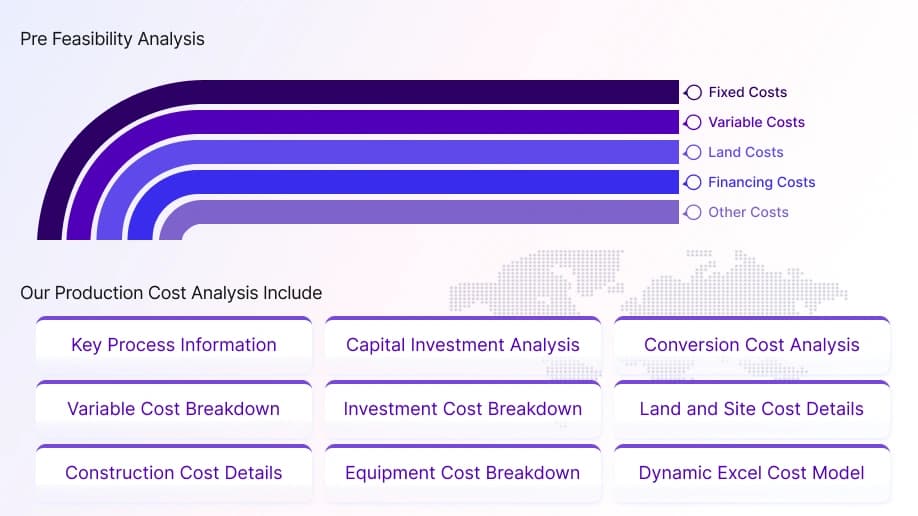
The report provides a detailed analysis essential for establishing a Levodopa production plant. It encompasses all critical aspects necessary for Levodopa production, including the cost of Levodopa production, Levodopa plant cost, Levodopa production costs, and the overall Levodopa production plant cost. Additionally, the study covers specific expenditures associated with setting up and operating a Levodopa production plant. These encompass production processes, raw material requirements, utility requirements, infrastructure needs, machinery and technology requirements, manpower requirements, packaging requirements, transportation requirements, and more.
Levodopa is a medication that benefits in managing symptoms related to Parkinson's disease. It functions by acting as a dopamine precursor, restoring the missing dopamine that controls symptoms of Parkinson's. It is very useful in treating Parkinson's disease symptoms like bradykinesia and rigidity. It is utilized in the in treatment of other symptoms that develops after encephalitis or due to Carbon Monoxide or Manganese poisoning. When combined with other medication, breakdown of levodopa is stopped before it reaches the brain and reduce its side effects like nausea. It is available in numerous formulations like immediate, controlled, and extended-release tablets and also as intestinal gel and inhaler.
The market of Levodopa is driven by several factors. It is a key medicine to help manage Parkinson's disease. The increase in cases of Parkinson's disease has resulted in its demand going up in pharmaceutical industry. It treats refractory symptoms, like bradykinesia and rigidity, associated to Parkinson’s disease, further contributing to its demand. It used to cure ailments like encephalitis or skin poisoning, making it a sought-after product in market. The fact that it can be administered in different tablets, gels and even inhalers make it easily accessible and effective. The changes in its demand as a major Parkinson’s disease medication, along with its production prices, market prices, and logistics, directly influence industrial Levodopa procurement in the global market.
Raw Material for Levodopa Production
According to the Levodopa production plant project report, the key raw materials used in the production of Levodopa include Genetically Modified Microorganisms (bacteria and fungi)-Precursor Amino Acid- Nutrients-Solvents.
Production Process of Levodopa
The extensive Levodopa production cost report consists of the following major industrial production process:
- From Genetically Modified Microorganisms, Precursor Amino Acid, Nutrients, and Solvents: The industrial production of Levodopa involves several steps. First, an amino acid precursor goes through fermentation with genetically modified microorganisms. The fermentation process takes place in controlled bioreactors, where optimal conditions, including pH, temperature, and nutrients, are provided to increase the production of Levodopa. After the fermentation, Levodopa is extracted and purified using solvents, chromatography, and crystallization.
Levodopa is a white to off-white crystalline powder. It is an odorless and tasteless compound. Its IUPAC name is (2S)-2-amino-3-(3,4-dihydroxyphenyl) propanoic acid. It has a molecular formula of CHNO and a molecular weight of around 197.19 g/mol. It is slightly soluble in water, and its solubility increases in acidic or alkaline solutions. It has a melting point of around 270°C and a boiling point of 419.12°C. Its partition coefficient ranges from -2.24 to -2.74, suggesting that it is hydrophilic. All these physical and chemical properties contribute to its effectiveness in reducing symptoms of Parkinson's disease.