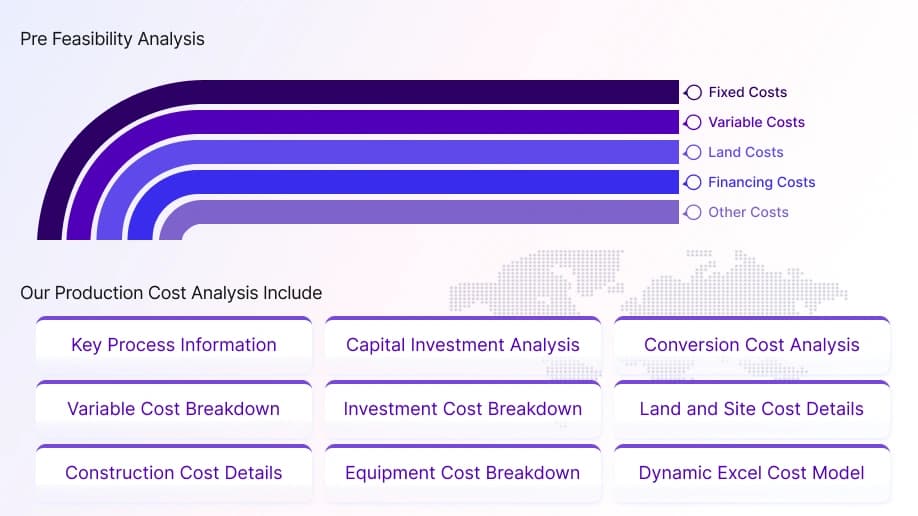
The report provides a detailed analysis essential for establishing a Levomepromazine production plant. It encompasses all critical aspects necessary for Levomepromazine production, including the cost of Levomepromazine production, Levomepromazine plant cost, Levomepromazine production costs, and the overall Levomepromazine production plant cost. Additionally, the study covers specific expenditures associated with setting up and operating a Levomepromazine production plant. These encompass production processes, raw material requirements, utility requirements, infrastructure needs, machinery and technology requirements, manpower requirements, packaging requirements, transportation requirements, and more.
Levomepromazine is a drug that is widely known for its antiemetic, analgesic, and antipsychotic activities. It is widely used as a medication for the treatment and management of schizophrenia, anxiety, bipolar disorder, and various psychotic disorders. Moreover, it is also utilized as an analgesic to manage moderate to severe pain, agitation, terminal restlessness, and certain sleep problems (insomnia). Additionally, it also finds its application as an antiemetic agent to control intractable nausea and vomiting.
The market for Levomepromazine is mainly driven by its application as a broad-spectrum antiemetic for controlling nausea and vomiting when other antiemetic medications are ineffective, which significantly boosts its market growth. Its utilization as an antipsychotic agent for the treatment of anxiety disorders, schizophrenia, and manic phases of bipolar disorder further enhances its demand in the medical and pharmaceutical industries. Furthermore, several critical factors, including the availability, pricing, and cost of raw materials, such as sodamide, etc., adherence to quality standards, supplier relationships, distribution, and logistics, and the effect of technological advancements, globally influence industrial Levomepromazine procurement to a great extent.
Raw Material for Levomepromazine
According to the Levomepromazine production plant project report, the major raw materials for Levomepromazine production include Sodamide-3-Methoxyphenthiazine- Anhydrous Xylene.
Production Process of Levomepromazine
The extensive Levomepromazine production cost report consists of the following industrial production process:
- Production from Sodamide: This method of production is initiated by the addition of sodamide to a boiling solution of 3-methoxyphenthiazine in anhydrous xylene to form a mixture, followed by heating it with agitation under reflux for 1 hour. Further, a solution of 1- dimethylamino-2-methyl-3-chloropropane in anhydrous xylene is added to the mixture, followed by heating under reflux for another 18 hours while maintaining the reaction temperature. After the mixture gets cooled, it is further agitated with water and a normal solution of methanesulfonic acid, followed by removing the xylene layer and washing acid liquors with ether. Further, the obtained aqueous phase is added with sodium hydroxide, followed by drying it over anhydrous potassium carbonate and concentrating it at normal pressure. Then, the obtained residue is distilled under reduced pressure, which results in the formation of 3-(3-methoxy-10- phenthiazinyl)-2-methyl-1-dimethylaminopropane or Levomepromazine as the final product.
Levomepromazine belongs to the class of phenothiazines. The molecular formula of the compound is C19H24N2OS, and its molar mass is 328.5 g/mol. The compound is also known as Methotrimeprazine or Levoprome. Moreover, the solubility of the compound in water is 20mg/L (at 25 °C), and the value of its dissociation constant is pka=9.19. It is generally stored in a temperature range of 2-8°C. Additionally, it finds its applications in the medical and pharmaceutical industry as an antipsychotic drug. This drug is mainly marketed under the brand name Nozinan (Aventis).