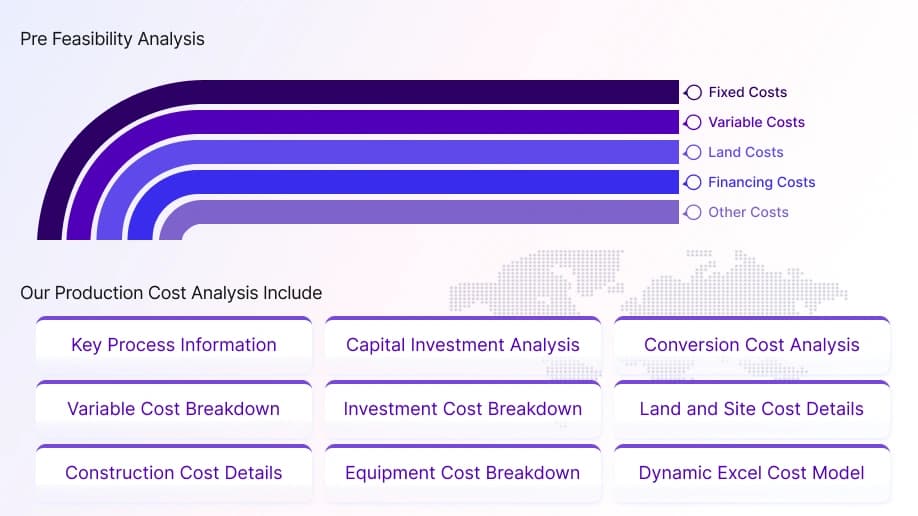
The report provides a detailed analysis essential for establishing a Linear Alkyl Benzene production plant. It encompasses all critical aspects necessary for Linear Alkyl Benzene production, including the cost of Linear Alkyl Benzene production, Linear Alkyl Benzene plant cost, Linear Alkyl Benzene production costs, and the overall Linear Alkyl Benzene production plant cost. Additionally, the study covers specific expenditures associated with setting up and operating a Linear Alkyl Benzene production plant. These encompass production processes, raw material requirements, utility requirements, infrastructure needs, machinery and technology requirements, manpower requirements, packaging requirements, transportation requirements, and more.
Linear Alkyl Benzene (LAB) is the primary feedstock used to produce LABSA (Linear Alkyl Benzene Sulphonate), which is the leading powder and liquid laundry detergent in the world. It is used as a specialty solvent and an ingredient in a few heat transfer fluids. It is also used to produce Linear Alkylbenzene Sulphonate (LAS), which finds application as a surfactant for making detergents and cleaners. It is employed across several industries, such as in the production of powder detergents, liquid detergents like dishwashing liquid, glass cleaners, and household scavengers; agricultural herbicides emulsion polymerization, as an emulsifier, as an emollient and moisturizing agent, to produce oily power cables and ink and paint solvents. Also, it finds use in the nuclear industry as a neutrino detector.
The market for Linear Alkyl Benzene is driven by its usage as a raw material in the production of Linear Alkylbenzene Sulfonic Acid (LABSA), which is used in household and industrial detergents. Its utilization in various applications, such as textile processing, agriculture (as a wetting agent in pesticides), and emulsion polymerization, amplifies its demand even more. Its usage as a surfactant in products such as shampoos and body washes, fuels its market in the personal care industry. Overall, industrial Linear Alkyl Benzene procurement is influenced by its application in various industries such as household products, textile, agricultural, and personal care industries, the availability of its raw material (kerosene), the cost of its raw material, biodegradability, environmental regulations, and technological advancements.
Raw Material for Linear Alkyl Benzene Production
According to the Linear Alkyl Benzene production plant project report, the key raw material used in the production of Linear Alkyl Benzene includes kerosene.
Production Process of Linear Alkyl Benzene
The extensive Linear Alkyl Benzene production cost report consists of the following major industrial production process:
- Production from kerosene: The production process of Linear Alkyl Benzene starts with kerosene, which is an important feedstock for linear paraffin. Linear paraffin undergoes dehydrogenation to form linear olefins. The linear olefin is reacted with benzene to produce Linear Alkyl Benzene.
Linear Alkyl Benzene (C6H5CnH2n + 1) is a family of organic compounds. Usually, n lies within 10 and 16, even though typically supplied as a tighter cut like C12-C15, C12-C13, and C10-C13 for detergent application. The CnH2n+1 chain is unbranched. It has a density in the range of 0.86-0.88 g/cm³ at 20°C. Its molecular weight is in the range of 240-254 g/mol. Linear Alkyl Benzene (LAB) comprises two groups, Alkyl and Benzene, which is also known as detergent alkyl. It appears to be a yellowish liquid. It is not soluble in water.