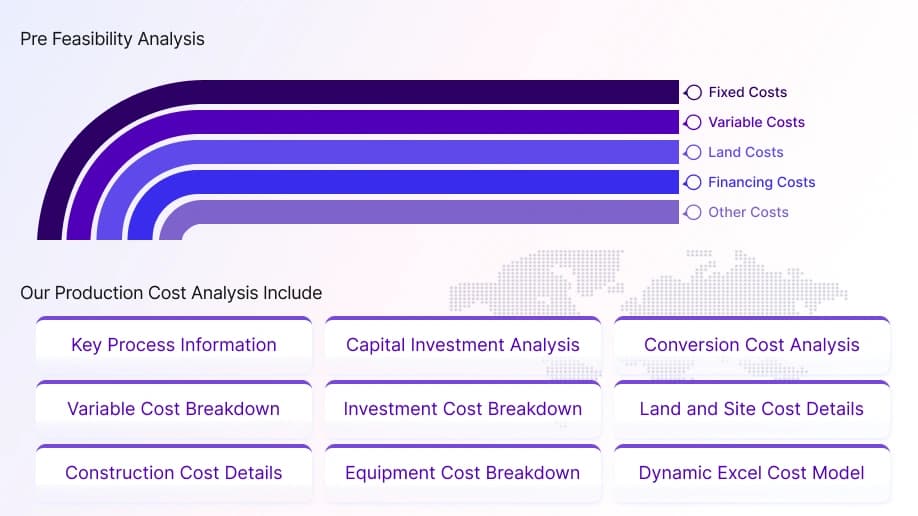
The report provides a detailed analysis essential for establishing a Lithium Niobate production plant. It encompasses all critical aspects necessary for Lithium Niobate production, including the cost of Lithium Niobate production, Lithium Niobate plant cost, Lithium Niobate production costs, and the overall Lithium Niobate production plant cost. Additionally, the study covers specific expenditures associated with setting up and operating a Lithium Niobate production plant. These encompass production processes, raw material requirements, utility requirements, infrastructure needs, machinery and technology requirements, manpower requirements, packaging requirements, transportation requirements, and more.
Lithium Niobate is an inorganic chemical compound that finds a wide range of applications in various industries. It is extensively utilized as an important material for optical waveguides, piezoelectric sensors, mobile phones, and several other optical uses. Moreover, it also finds its application in the production of optical modulators that play a crucial role in fiber optic communication systems. Additionally, the compound is also employed in medical diagnostics and ultrasound imaging due to its strong piezoelectric properties.
The market for lithium niobate is driven by its huge applications as a material in mobile phones, piezoelectric sensors, optical modulators, and switches, which remarkably strengthens its demand in the electronics and telecommunications industry. Moreover, its utilization in medical ultrasound equipment and industrial ultrasonics further accentuates its demand in the healthcare and medical devices industry and the industrial production industry. Furthermore, several factors influence industrial Lithium Niobate procurement, such as the availability of raw materials (niobium ethoxide, lithium acetate, etc.), cost and pricing, regulatory compliance, quality standards, technological advancements, environmental considerations, sustainability practices, distribution (including trading and shipping), logistics, safety standards, etc.
Raw Material for Lithium Niobate Production
According to the Lithium Niobate production plant project report, the major raw materials for Lithium Niobate production include Niobium Ethoxide-Lithium Acetate- Benzoylacetone.
Production Process of Lithium Niobate
The extensive Lithium Niobate production cost report consists of the following industrial production process:
- Production via Chemical Modification: This method of production involves the production of lithium niobate film through the optimization/modification mechanism of BzAcH (benzoylacetone) by using niobium pentachloride, niobium ethoxide, lithium acetate, and anhydrous ethanol, followed by the heat treatment at 700 °C. The process utilizes niobium ethoxide and lithium acetate as raw materials and further adds the chemical modifier BzAcH to obtain a stable lithium niobate sol.
Lithium Niobate Lithium Niobate appears as a colorless solid that does not dissolve in water. Moreover, the chemical formula for the compound is LiNbO3, and its molecular mass is 147.846 g/mol. The IUPAC name of Lithium Niobate is Lithium;Oxido(dioxo)niobium. The melting point of the compound is 1275°C. The compound's density is 4659 g/cm3, and the refractive index is 457nm. The compound is generally stable, but it is not compatible with strong oxidizing agents. The compound is also known as Lithium niobium oxide (LiNbO3).