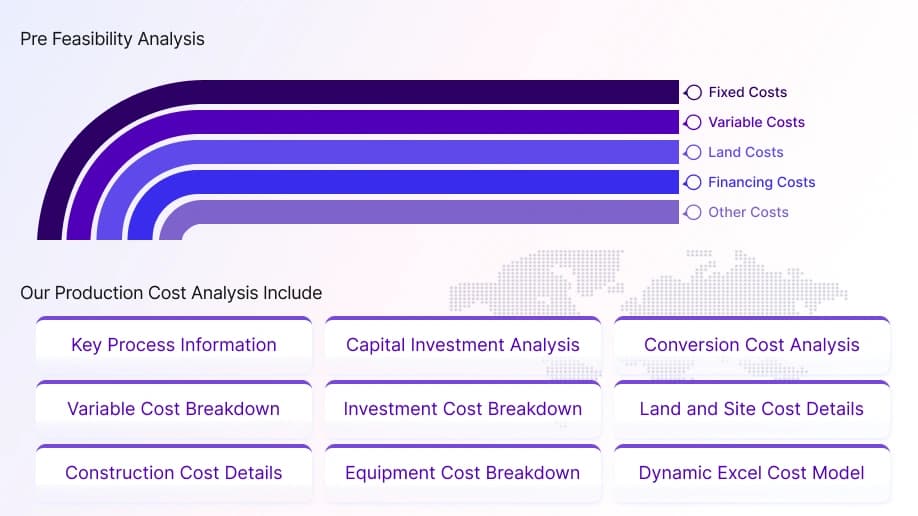
The report provides a detailed analysis essential for establishing a Linear Low-Density Polyethene (LLDPE) production plant. It encompasses all critical aspects necessary for Linear Low-Density Polyethene (LLDPE) production, including the cost of Linear Low-Density Polyethene (LLDPE) production, Linear Low-Density Polyethene (LLDPE) plant cost, Linear Low-Density Polyethene (LLDPE) production costs, and the overall Linear Low-Density Polyethene (LLDPE) production plant cost. Additionally, the study covers specific expenditures associated with setting up and operating a Linear Low-Density Polyethene (LLDPE) production plant. These encompass production processes, raw material requirements, utility requirements, infrastructure needs, machinery and technology requirements, manpower requirements, packaging requirements, transportation requirements, and more.
Linear Low-Density Polyethene (LLDPE) is a chemical compound used in various applications like film, roto molding, injection molding, monofilament, stretched tape and yarn, and caps and closure. Furthermore, it is a commodity thermoplastic that has its main application in the packaging industry since it can be employed for making film-like materials that hold significant tensile strength. These materials offer thinner films without giving up strength, losing the material, and the benefit of lowering prices. Also, LLDPE is employed in end-uses such as shrink/stretch film, extrusion coating, and injection molding, etc.
The market for Linear Low-Density Polyethene (LLDPE) is driven by its usage for food packaging applications, such as bags and films, which elevates its demand in the food and packaging industries. The rising demand for convenience foods and ready-to-eat meals amplifies its market appeal. Its utilization in applications such as agricultural films to protect crops boosts its demand in the agricultural industry. Its usage as moisture barrier in construction fuels its demand in the construction industry. In addition, the higher tensile strength, superior impact, and puncture resistance of the material make it a great substitute for its low-density polyethylene (LDPE) counterpart, which further contributes to its market demand.
Overall, industrial Linear Low-Density Polyethene (LLDPE) procurement is influenced by its application in various industries such as food, packaging, consumer goods, automotive, agriculture, and construction industries, the availability of its raw materials (octene, ethylene, hexene, and butene), the cost of its raw materials, the rising demand for convenience foods and ready-to-eat meals, technological advancements, urbanization and industrialization, and sustainability trends.
Raw Material for Linear Low-Density Polyethene (LLDPE) Production
According to the Linear Low-Density Polyethene (LLDPE) production plant project report, the key raw materials used in the production of Linear Low-Density Polyethene (LLDPE) include octene-ethylene; hexene-butene.
Production Process of Linear Low-Density Polyethene (LLDPE)
The extensive Linear Low-Density Polyethene (LLDPE) production cost report consists of the following major industrial production process:
- Production via copolymerization: The production process of Linear Low-Density Polyethylene involves polymerization via two techniques: solution polymerization and gas-phase polymerization. In the former technique, octene is copolymerized with ethylene to obtain powder-form polymer, which is mixed with stabilizers to convert it into pellet forms. In contrast, the latter technique includes hexene and butene in the copolymerization of ethylene, which gives melted polymer that is combined with a stabilizer and squeezed out in pellet forms to be used in further production of plastic products.
LLDPE, or Linear low-density polyethylene, is a semi-crystalline polymer that has several short branches in its primary molecular chains. It is usually made using one of three different co-monomers classified as alpha-olefins, namely, octene, hexene, and butene. LLDPE is a low-density type of polymer that has a density range of 0.915 and 0.930 g/cm3 and a few numbers of short chain branches.
The properties of LLDPE include flexibility with high impact strength, excellent chemical resistance, translucency, natural milky color, good water vapor, and alcohol barrier properties, along with stress crack and impact resistance. Other characteristics of the material include being puncture-resistant, resistant to oxidation, great flexibility, excellent barrier properties, resistant to oxidation, High impact strength, UV resistance, great environmental stress cracking resistance, and ability to retain strength when in film form.