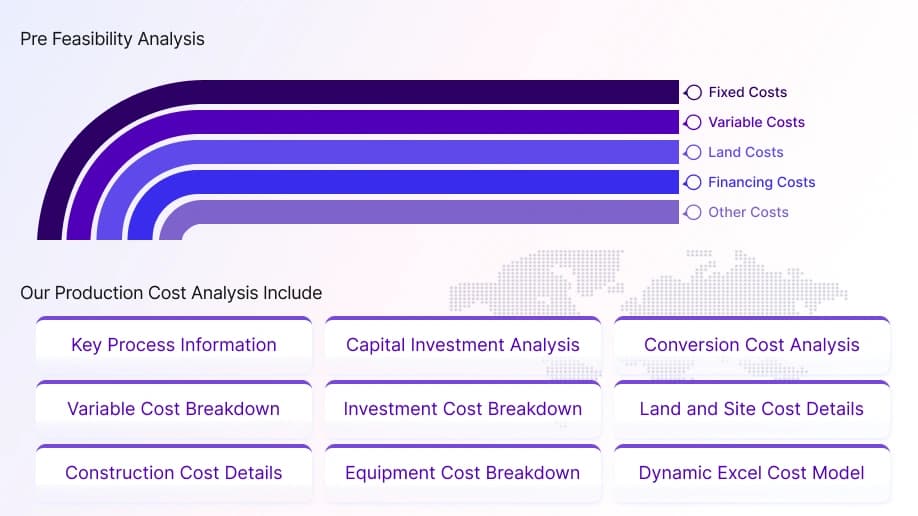
The report provides a detailed analysis essential for establishing an LPG production plant. It encompasses all critical aspects necessary for LPG production, including the cost of LPG production, LPG plant cost, LPG production costs, and the overall LPG production plant cost. Additionally, the study covers specific expenditures associated with setting up and operating an LPG production plant. These encompass production processes, raw material requirements, utility requirements, infrastructure needs, machinery and technology requirements, manpower requirements, packaging requirements, transportation requirements, and more.
Liquified petroleum gas (LPG) is a source of fuel which is mainly used in domestic applications like heating, cooking etc. It is employed in household appliances, such as cooktops, gas stoves, ovens, fireplaces, and heaters, as well as in geezers (water heaters or boilers). In addition, it is also used in other applications such as production applications, as a fuel for cars, and for powering cogeneration plants.
The market for LPG is driven by its usage in various industrial applications, such as production processes, food processing, and as a feedstock for petrochemical production. The global rise in the adoption of LPG as an autogas alternative in the transportation sector coupled with the demand for LPG vehicles as an eco-friendlier option compared to gasoline and diesel, elevates its market growth. Rapid urbanization and population growth in emerging economies, leads to increased consumption of LPG for domestic cooking and heating.
The increasing number of cooking gas connections in urban areas also enhances accessibility and usage among consumers, which boosts its market expansion. Also, government programs to encourage the adoption of LPG, such as subsidies for LPG connections and cylinders, in developing countries, like India's Pradhan Mantri Ujjwala Yojana that aims to provide access to clean cooking fuel for rural households, further drives industrial LPG procurement.
Raw Material for LPG Production
According to the LPG production plant project report, the key raw materials used in the production of LPG include natural gas; crude oil.
Production Process of LPG
The extensive LPG production cost report consists of the following major industrial production processes:
- Production from natural gas: The production process of LPG involves recovering it from "wet" natural gas, which contains condensable heavy petroleum compounds, through absorption. The gas is then distilled to separate the lighter fractions. After distillation, the product is treated to remove impurities such as hydrogen sulfide, carbon dioxide, and water. The final LPG product is transported via pipelines and specially designed seagoing tankers for distribution.
- Production from crude oil: The production process of LPG occurs via the refining of crude oil, where it is separated through fractional distillation. The crude oil is heated, which causes the hydrocarbons to vaporize and rise in a distillation column. LPG, found in the lighter fractions, condenses at higher levels. It is then cooled, compressed into a liquid, and stored for distribution.
LPG, or liquefied petroleum gas, is a liquid mixture comprising the volatile hydrocarbons propene, butene, propane, and butane. It is used extensively for both domestic and industrial uses. It is a non-renewable energy source derived from crude oil and natural gas. LPG is made up of hydrocarbons comprising three or four carbon atoms. It is an odorless and colorless gas that is given an added smell to detect any leaks.
It is highly flammable and non-toxic, but inhaling it in large quantities can cause fainting, dizziness, or suffocation. Its chemical composition includes Propane and Butane. In a gaseous state, it expands about 270 times its volume as a liquid. It has almost no sulfur content, making it a clean-burning fuel. LPG can be liquefied at moderate pressure and can be easily stored, condensed, packaged, and used, which makes it a perfect source of energy in a wide range of applications.