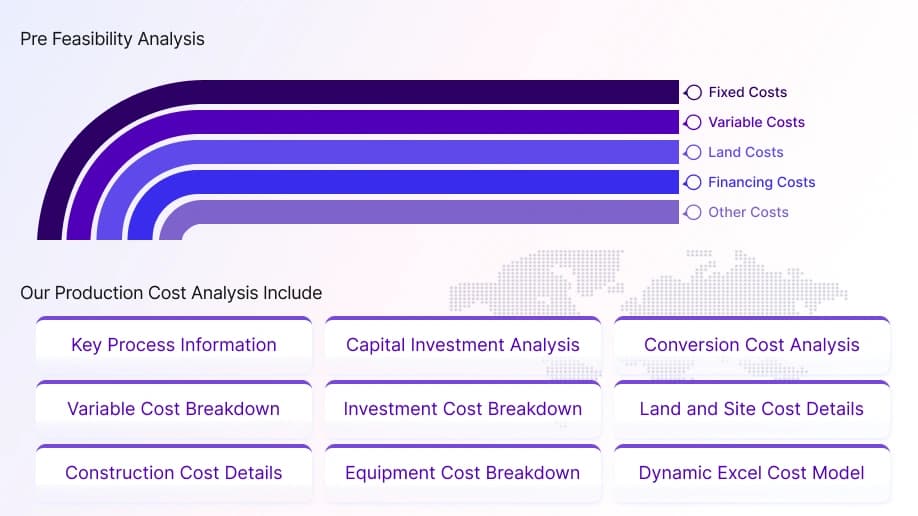
The report provides a detailed analysis essential for establishing a Megestrol Acetate production plant. It encompasses all critical aspects necessary for Megestrol Acetate production, including the cost of Megestrol Acetate production, Megestrol Acetate plant cost, Megestrol Acetate production costs, and the overall Megestrol Acetate production plant cost. Additionally, the study covers specific expenditures associated with setting up and operating a Megestrol Acetate production plant. These encompass production processes, raw material requirements, utility requirements, infrastructure needs, machinery and technology requirements, manpower requirements, packaging requirements, transportation requirements, and more.
Megestrol Acetate is a steroid ester compound that majorly serves as an FDA-approved medication used in medical and pharmaceutical industries. It is widely utilized as an oral drug for the palliative treatment of endometrial carcinoma and breast cancer (i.e., recurrent, inoperable, or metastatic disease). Moreover, it also finds its application as a medicine to treat anorexia and cachexia. It is often utilized as an antineoplastic agent for the treatment of various types of malignancy. Additionally, it is also employed as an adjunct to other therapies for the treatment of types of cancer and other conditions.
The market of Megestrol Acetate is led by its industrial application as an antineoplastic drug for the treatment of advanced diseases in breast cancer and endometrial cancer, which significantly boosts its demand in the medical and pharmaceutical industries.
Moreover, its utilization as a synthetic oral contraceptive and as an oral synthetic drug for the treatment of anorexia and cachexia or unexplained weight loss in patients with AIDS further enhances its demand in the pharmaceutical industry. Its employment as a combination drug for the treatment of certain malignancies and various therapeutic treatments effectively promotes its market expansion.
Furthermore, several factors influence industrial Megestrol Acetate procurement, such as the availability of raw materials (sodium acetate, etc.), cost and pricing, compliance with pharmaceutical regulations, quality standards, technological advancements, environmental considerations, sustainability practices, distribution (including trading and shipping), logistics, safety standards, etc.
Raw Material for Megestrol Acetate Production
According to the Megestrol Acetate production plant project report, the major raw materials for Megestrol Acetate production include 17α-Acetoxy-6-methylenepregn-4-ene-3,20-dione-Sodium Acetate-Ethanol - 4-Methyl-1-cyclohexene- Activated Carbon.
Production Process of Megestrol Acetate
The extensive Megestrol Acetate production cost report consists of the following industrial production process:
- Production from Sodium Acetate: This method of production is initiated by heating together 17α-acetoxy-6-methylenepregn-4-ene-3,20-dione, sodium acetate, and 0.06 part of palladium/carbon in 10 parts of ethanol and 4-methyl-1-cyclohexene at reflux while stirring continuously, followed by drying, which results in the formation of crude megestrol acetate. Further, the crude product obtained is dissolved in methanol under hot conditions, followed by concentrating the liquid, cooling, and centrifugation. Then, activated carbon is added and the crystals obtained are removed and washed with acetone, followed by drying gives megestrol acetate as the final product.
Megestrol Acetate is a type of acetate salt of megestrol, which is a synthetic derivative of progesterone (natural female sex hormone) and has potential anti-estrogenic properties. The flash point of the compound is 218.7°C, and it should be stored in a dry place at room temperature. The molecular formula of the compound is C24H32O4, and its molecular weight is 384.5 g/mol. Moreover, the compound is also known as Megeron or Magestin.
The density of the compound is 1.0474 g/cm3, and it does not dissolve in water but is readily soluble in acetone and sparingly soluble in alcohol. Additionally, the melting point and the boiling point of the compound are 214°C and 431.17°C, respectively. It is recommended to store the compound at 25°C and below 40°C.