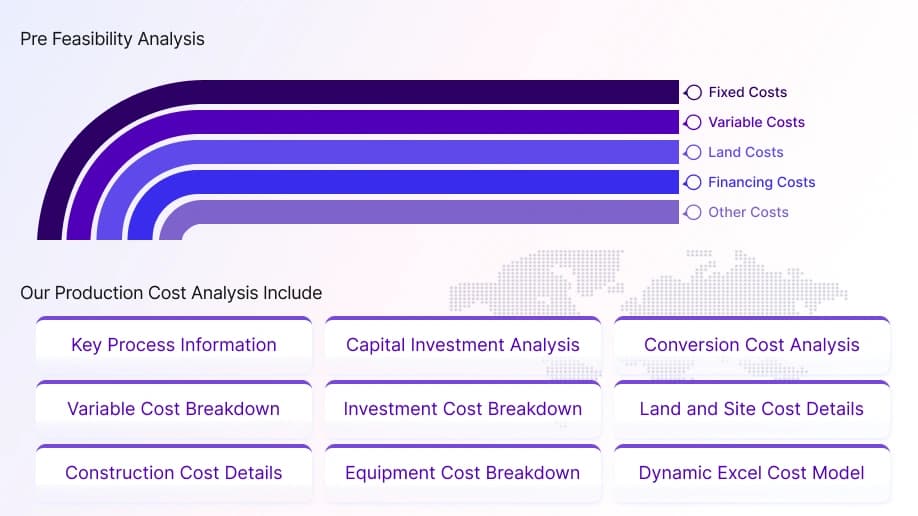
The report provides a detailed analysis essential for establishing a micanite production plant. It encompasses all critical aspects necessary for micanite production, including the cost of micanite production, micanite plant cost, micanite production costs, and the overall micanite production plant cost. Additionally, the study covers specific expenditures associated with setting up and operating a micanite production plant. These encompass production processes, raw material requirements, utility requirements, infrastructure needs, machinery and technology requirements, manpower requirements, packaging requirements, transportation requirements, and more.
Micanite is a composite insulating material made of mica flakes bonded together with a resin or varnish, used primarily in electrical applications for its high dielectric strength and heat resistance. It is extensively used as an insulating material in electric motors, field coil insulation, and other electronic equipment. Moreover, it also finds its application in electric vehicles to insulate electrical components and manufacture certain vehicle parts, such as clutch pads, seatbelts, brake shoes, etc. It is also used in the manufacture of defense equipment due to its excellent insulation properties and heat resistance. Additionally, it is utilized to provide insulation for industrial ovens, heaters, etc.
The market for micanite is majorly led by its wide range of applications as an electrical insulator used in electric motors, generator armatures, transformers, and switchgear insulation, which remarkably promotes its demand in the electrical and electronics industries. Moreover, its usage in the automotive, aerospace, and defense industries due to its exceptional characteristics of high tensile strength, lightweight, and thermal resistance further boosts its market expansion.
Additionally, its employment for machinery insulation, effectively contributes to its demand in the industrial machinery and production industries. Furthermore, several factors influence industrial micanite procurement, such as the availability of raw materials (raw mica), cost, and pricing, regulatory compliance, quality standards, technological advancements, environmental considerations, sustainability practices, distribution (including trading and shipping), logistics, safety standards, etc.
Raw Material for Micanite Production
According to the Micanite production plant project report, the major raw material for Micanite production includes Mica Lamellae (Splittings).
Production Process of Micanite
The extensive Micanite production cost report consists of the following industrial production process:
- Production from Mica Lamellae: This method of production involves multiple steps to convert raw mica into a complex material called Micanite. The production process uses mica lamellae, i.e., called “Splittings,” that are bonded or attached by various binding agents, which include epoxy, shellac, alkyd, or silicone, to obtain Micanite of desired characteristics for different applications. Moreover, changes can be made in the type of mica used and the quantity of binding agents to form Micanite with varied characteristics, like thin, stiff, flexible, or molded products.
Micanite is a sheet-like material that is made up of mica lamellae. It possesses exceptional properties of thermal and dielectric resistance, as it can withstand temperatures up to 600°C. It comprises 90% of the natural mica powder along with 10% of synthetic resin binder. It is mainly used for insulating purposes. These are flat sheets with a glossy surface. In general, its density is around 2.7 to 2.9 g/cm3. Moreover, this complex material has high tensile strength, durability, and resistance to mechanical stress. It is moisture-resistant and reliable in humid conditions.