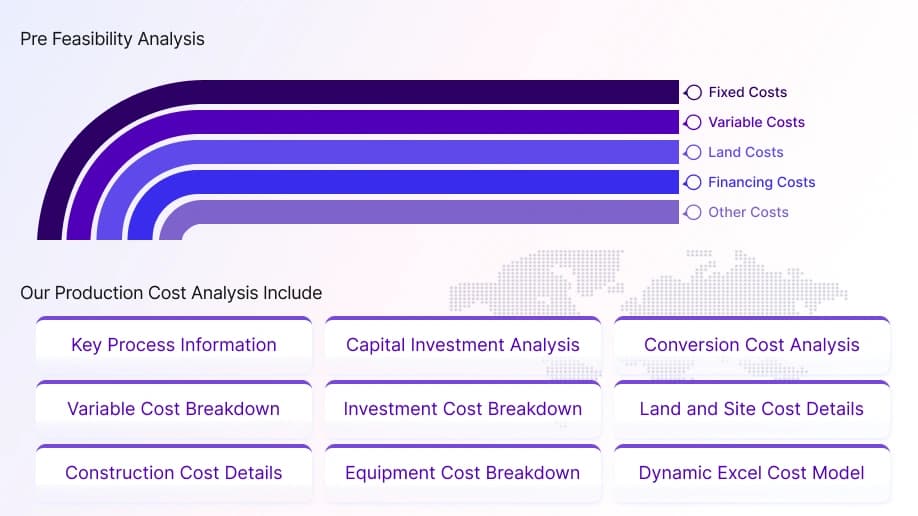
The report provides a detailed analysis essential for establishing a Milling wheat production plant. It encompasses all critical aspects necessary for Milling wheat production, including the cost of Milling wheat production, Milling wheat plant cost, Milling wheat production costs, and the overall Milling wheat production plant cost. Additionally, the study covers specific expenditures associated with setting up and operating a Milling wheat production plant. These encompass production processes, raw material requirements, utility requirements, infrastructure needs, machinery and technology requirements, manpower requirements, packaging requirements, transportation requirements, and more.
Milling wheat can be defined as the process of blending and grinding a variety of wheat and turning it into flour. It is extensively employed in the food industry and has various applications. It is transformed into flour for commercial purposes. Cleaning, drying, and tempering are the steps involved in the production of milling wheat. Milling wheat is used to make pasta, crackers, crispbreads, cereal bars, biscuits, cakes, crumpets, sauces, bread, muffins, noodles, and other confectionary foods, which increases demand for it globally. Moreover, paper, bioplastics, and adhesives are all currently made from wheat meal.
The growth in population, along with an increase in global wheat consumption, are the main market drivers. Consumers are increasingly looking for healthier food options, which has increased milling wheat consumption. The market for Milling wheat is prominently driven by its demand as a crucial component for producing food products (like bread, pasta, cereal bars, crackers, cakes, noodles, etc.) and convenience food products, which boosts its demand in the food, confectionary, and bakery industry.
Milling wheat is becoming more popular in the health and wellness industry because of clean-label trends and consumer demand for natural ingredients in snacks and convenience food products. Additionally, milling wheat is also utilized in the production of paper, adhesives, and bioplastics, which enhance its demand for the pulp & paper, adhesive, and plastic industries. Furthermore, industrial Milling wheat procurement is governed by various factors, including the availability and production cost of its raw materials, which include wheat grains, the market prices of milling wheat, its distribution (covering transportation and trading activities), logistics, etc.
Raw Material for Milling Wheat Production
According to the Milling wheat production plant project report, the major raw material for Milling wheat production includes Wheat Grains.
Manufacturing Process of Milling Wheat
The extensive Milling Wheat production cost report consists of this major industrial production process:
- Production via Cleaning, Conditioning, Gristing, Separating and Milling: The first step in the procedure is to clean and condition the wheat grains to remove the bran. Then, after gristing the outer bran portion of wheat is separated, followed by crushing or milling the wheat and sifting. The obtained wheat is again crushed and sieved to finally produce milled wheat or wheat flour.
Milling Wheat comprises separating and distributing the bran and germ from the endosperm of the wheat to make fine flour. In order to produce flour, the milling of wheat goes through various steps. Wheat has various essential functions in your body. The selenium content of milling wheat depends on the soil. It is found in whole grains, legumes, fruits, and vegetables.
Due to variations in soil and climate, milling wheat’s nutritional makeup varies somewhat. The kernel's average composition is as follows: 12% water, 70% carbs, 12% protein, 2% fat, 1.8 % minerals, and 2.2 % crude fibres. Although thiamin, riboflavin, niacin, and trace levels of vitamin A are present, the majority of those elements are removed along with the bran and germ during the milling process.