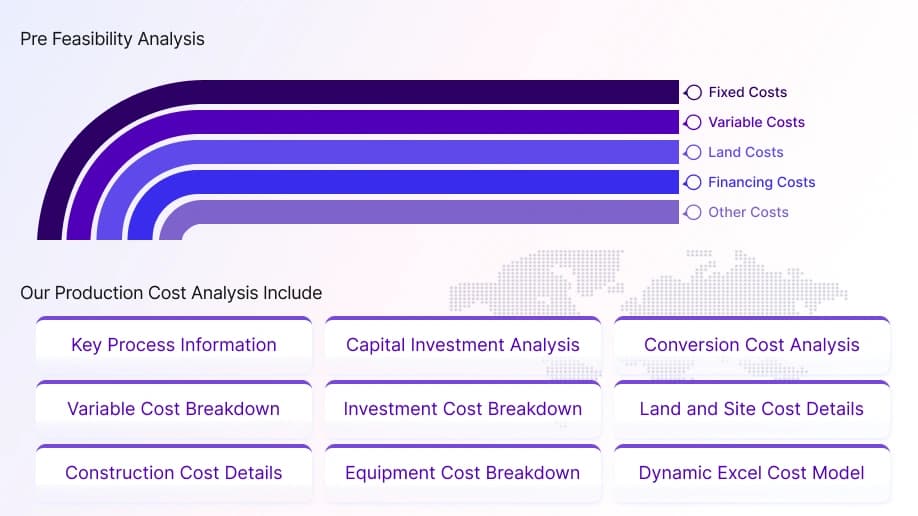
The report provides a detailed analysis essential for establishing a Natamycin production plant. It encompasses all critical aspects necessary for Natamycin production, including the cost of Natamycin production, Natamycin plant cost, Natamycin production costs, and the overall Natamycin production plant cost. Additionally, the study covers specific expenditures associated with setting up and operating a Natamycin production plant. These encompass production processes, raw material requirements, utility requirements, infrastructure needs, machinery and technology requirements, manpower requirements, packaging requirements, transportation requirements, and more.
Natamycin is an amphoteric antifungal drug that finds major applications in medical and pharmaceutical industries. It is widely utilized as a fungicide for the treatment of fungal infections of the eyes, including infections of conjunctiva, eyelids, and cornea. Moreover, it also finds its application as a food preservative in various food products, such as yogurt, wine, juices, cheese, etc., to inhibit the growth of mold on these products. Additionally, it is also employed in agriculture for controlling infections caused by agricultural fungi and protecting the crops.
The market for Natamycin is primarily driven by its usage as a topical medication to treat fungal infections of the eyes, which include fungal blepharitis, conjunctivitis, and keratitis, which remarkably boosts its demand in the pharmaceutical industries. Its utilization in the preservation of a wide range of food products from contamination or developing mold and increasing their shelf life further promotes its demand in the food and beverage industry. Additionally, its employment in protecting crops from agriculture fungi that infect various crops, including mushrooms, tomatoes, strawberries, etc., significantly accelerates its demand in the agriculture sector. Furthermore, several factors influence industrial Natamycin procurement, such as the source and its purity, cost, and pricing, compliance with medical and pharmaceutical regulations, quality standards, technological advancements, environmental considerations, sustainability practices, distribution (including trading and shipping), logistics, safety standards, etc.
Raw Material for Natamycin Production
According to the Natamycin production plant project report, the major raw material for Natamycin production includes Streptomyces natalensis.
Manufacturing Process of Natamycin
The extensive Natamycin production cost report consists of the following industrial production process:
- Production via Submerged Fermentation: This method of production involves the process of fermentation in a medium that contains a pure inoculum of Streptomyces species under an optimized culture medium, carbon source, and process parameters to obtain Natamycin as the product. In this method, a pure strain of Streptomyces natalensis, S. lydicus, or S. natalensis undergoes fermentation under fed-batch cultivation in an optimized culture medium, carbon source, dissolved oxygen, and feed additives, which results in the formation of natamycin. Further, the natamycin produced undergoes a purification step that includes flash column chromatography and ultrafiltration to obtain pure natamycin.
Natamycin is a kind of polyene amphoteric macrolide antibiotic that has antifungal activities. Moreover, the molecular formula of the compound is C33H47O13N, and its molar mass is 665.7 g/mol. It is a form of drug that is also marketed by the name Pimaricin or Myprozine. Additionally, the compound appears as a white or creamy-white crystalline powder with an isoelectric PH of 6.5. The melting point of the compound is 290 °C.