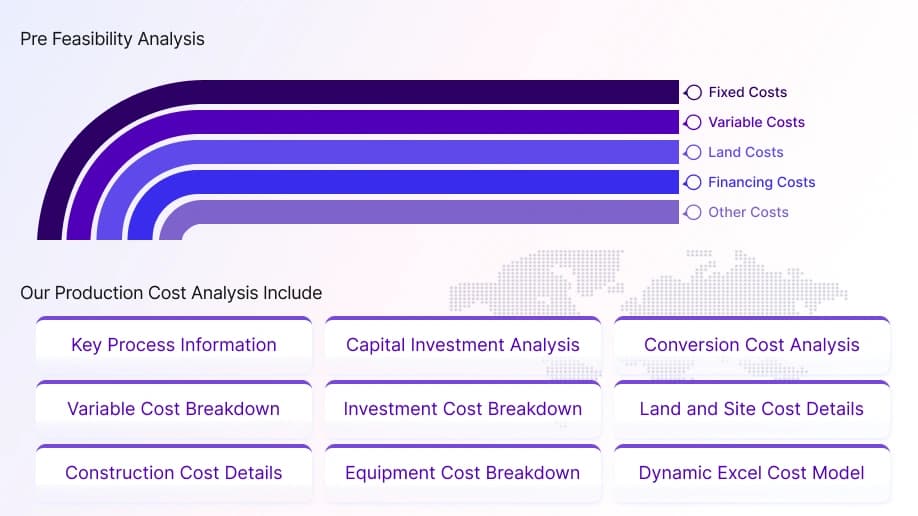
The report provides a detailed analysis essential for establishing a Nefazodone Hydrochloride production plant. It encompasses all critical aspects necessary for Nefazodone Hydrochloride production, including the cost of Nefazodone Hydrochloride production, Nefazodone Hydrochloride plant cost, Nefazodone Hydrochloride production costs, and the overall Nefazodone Hydrochloride production plant cost. Additionally, the study covers specific expenditures associated with setting up and operating a Nefazodone Hydrochloride production plant. These encompass production processes, raw material requirements, utility requirements, infrastructure needs, machinery and technology requirements, manpower requirements, packaging requirements, transportation requirements, and more.
Nefazodone Hydrochloride is a phenyl piperazine antidepressant that is derived synthetically and is primarily used in the pharmaceutical industry. It is widely utilized as an antidepressant drug for the treatment of mental depression, as it modifies serotonin transmission. Moreover, it finds its application as an oral medication that is prescribed for the treatment of anxiety disorders, panic disorder, and major depressive disorder (MDD).
The market for Nefazodone Hydrochloride is driven by its usage as a selective serotonin 5-HT2 receptor antagonist to treat depression by regulating neurotransmitters (serotonin and norepinephrine) in the brain, which significantly boosts its demand in the medical industry. Additionally, its employment as an oral antidepressant in the medical and pharmaceutical industry for the treatment of major depressive disorder (MDD) and anxiety issues further enhances its market growth. Furthermore, several factors influence industrial Nefazodone Hydrochloride procurement, such as the availability of raw materials (sodium bicarbonate, etc.), cost and pricing, regulatory compliance, quality standards, technological advancements, environmental considerations, sustainability practices, distribution (including trading and shipping), logistics, safety standards, etc.
Raw Material for Nefazodone Hydrochloride Production
According to the Nefazodone Hydrochloride production plant project report, the major raw materials for Nefazodone Hydrochloride production include 1-(3-Chloropropyl)-4-(3-chlorophenyl)piperazine Hydrochloride- Phenoxypropionic Acid- Thionyl Chloride- Acetone- Sodium Azide- Sodium Bicarbonate-Brine.
Manufacturing Process of Nefazodone Hydrochloride
The extensive Nefazodone Hydrochloride production cost report consists of the following industrial production process:
- Production via Chemical Synthesis: This method of production involves three major steps: The first step involves synthesizing 1-(3-chloropropyl)-4-(3-chlorophenyl)piperazine hydrochloride, 1-(3-chlorophenyl)-4-(hydrazinopropyl)piperazine. The second step involves dissolving phenoxypropionic acid in 4 equivalents of thionyl chloride and heating to reflux until the evolution of HCL stops. Further, the solution is cooled to room temperature and is concentrated under reduced pressure to form phenoxypropionyl chloride. The third step involves dissolving the obtained compound (phenoxypropionyl chloride) in 100 ml acetone, followed by the dropwise addition of sodium azide and cooling with an ice bath. Further, the reaction mixture obtained is heated to room temperature and stirred for 30 minutes, which results in the concentration of the solution. The residue is then dissolved in ether and washed with saturated sodium bicarbonate and brine, followed by separating, drying, and concentrating the organic phase to give phenoxypropionyl azide (solidifies on cooling), which leads to the synthesis of Nefazodone hydrochloride as the final product.
Nefazodone Hydrochloride is a derivative of phenylpiperazine that has nefazodone as the active moiety. It appears as a white solid that has a melting point of 186-188°C. The molecular formula of the compound is C25H33Cl2N5O2, and its molecular weight is 506.47 g/mol. Moreover, the compound is stored at room temperature and in an inert atmosphere. It is soluble in DMSO-11 mg/mL at 60°C. Additionally, the compound serves as a trazodone-type antidepressant with minimal side effects. The compound is majorly marketed under the brand names Serzone, Dutonin, and Nefadar.