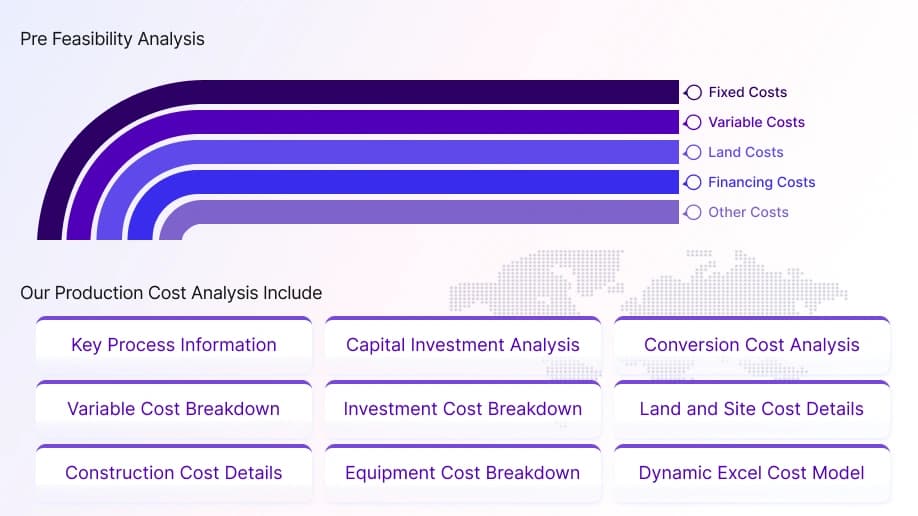
The report provides a detailed analysis essential for establishing a Nickel production plant. It encompasses all critical aspects necessary for Nickel production, including the cost of Nickel production, Nickel plant cost, Nickel production costs, and the overall Nickel production plant cost. Additionally, the study covers specific expenditures associated with setting up and operating a Nickel production plant. These encompass production processes, raw material requirements, utility requirements, infrastructure needs, machinery and technology requirements, manpower requirements, packaging requirements, transportation requirements, and more.
The report provides a detailed analysis essential for establishing a Nickel production plant. It encompasses all critical aspects necessary for Nickel production, including the cost of Nickel production, Nickel plant cost, Nickel production costs, and the overall Nickel production plant cost. Additionally, the study covers specific expenditures associated with setting up and operating a Nickel production plant. These encompass production processes, raw material requirements, utility requirements, infrastructure needs, machinery and technology requirements, manpower requirements, packaging requirements, transportation requirements, and more.
Nickel is a metallic element that is widely used for armor plating and stainless-steel production. It is resistant to corrosion and high temperatures; hence, it can be used in gas turbines and rocket engines. The potential application of the metal is for producing several superalloys that have properties like ductility, strength, heat, and corrosion resistance. It is great for making alloys, which are further employed in making products like toasters, electric ovens, desalination plants for converting seawater into fresh water, in boat propeller shafts and turbine blades.
It is mostly used to produce stainless steel, which comprises iron, chromium, and nickel. Furthermore, it is also used in rechargeable batteries (like, nickel-cadmium batteries), foundry products, plating, for making coins, as well as catalysts and other chemicals. Moreover, it also finds usage in several end-user applications, such as in the military, consumer products, marine, industrial, transport/aerospace, and architecture.
Nickel is primarily used in metal, foundry, construction, and production industries to manufacture products like electric ovens, toasters, turbine blades, etc., which enhances its market expansion. This chemical element resists corrosion and high temperatures, and is widely used to plate other metals to protect them, which adds value to this product among metal and production industries. Additionally, nickel is an alloying element that enhances its properties such as weldability and ductility; it is often employed in making coins, rechargeable batteries, boat propeller shafts, transport & aerospace components like turbine blades of the engine, and other foundry products, which further increases its demand in the electronic, marine, automotive, and aerospace industries. Moreover, it is also widely utilized to produce stainless steel, military batteries for propulsion and storage, which accentuates its market growth for defence industry. Furthermore, several factors influence industrial nickel procurement, such as the cost and availability of its feedstock (sulphide ore and lateritic ore), the market prices of nickel, environmental regulations, quality standards, and its distribution, which includes trading and transportation, logistics, etc.
Raw Material for Nickel Production
According to the Nickel production plant project report, the major raw materials for Nickel production include Sulphide Ore; Lateritic Ore.
Manufacturing Process of Nickel
The extensive Nickel production cost report consists of the following industrial production process:
- Production From Sulphide Ore: The sulfidic ore is put in a furnace with hot oxygen in it. Ore is smelted to create 45 percent nickel. Further, to eradicate all residues of iron and sulfide, oxygen is supplied in this step. Nickel matte is refined using the fluid bed roasting method to achieve 95% purity.
- Production From Lateritic Ore: In this process nickel is extracted from lateritic ore through extractive metallurgy. Lateritic ore is mined for nickel via extractive metallurgy. Extraction is the process of removing moisture through roasting. Subsequently, chemically bonded water and nickel oxide are eliminated in the reduction furnace. Nickel matte is refined using the fluid bed roasting method to achieve 95% purity.
Nickel (Ni) is a chemical/metallic element classified as a ferromagnetic metal belonging to the Group 10 of the periodic table. It occurs naturally in the environment, which is the fifth most common element on the planet and can be found in the crust and core of the earth. It can be found in animals, plants, and seawater in tiny amounts. Nickel appears to be silvery-white with a shiny and lustrous look.
It is resistant to corrosion and oxidation. It is hard, ductile, and malleable and is a relatively good conductor of electricity and heat. It has an atomic weight of 58.71 and an atomic number of 28. Its density is 8.902. It gradually dissolves in dilute acids except for nitric acid. It has a melting point of 1453° C and a boiling point is 2913 °C.