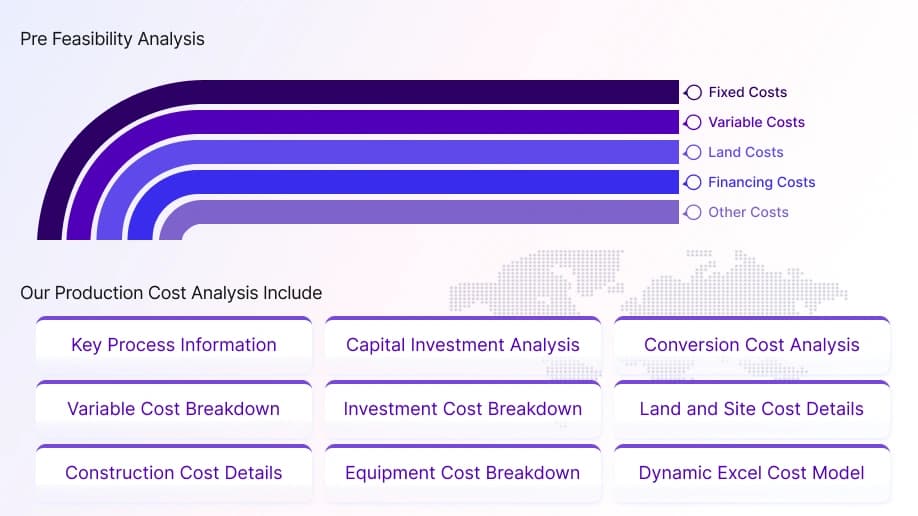
The report provides a detailed analysis essential for establishing a Nintedanib production plant. It encompasses all critical aspects necessary for Nintedanib production, including the cost of Nintedanib production, Nintedanib plant cost, Nintedanib production costs, and the overall Nintedanib production plant cost. Additionally, the study covers specific expenditures associated with setting up and operating a Nintedanib production plant. These encompass production processes, raw material requirements, utility requirements, infrastructure needs, machinery and technology requirements, manpower requirements, packaging requirements, transportation requirements, and more.
Nintedanib is an indolinone-derived orally active drug known for its potent antiangiogenic activity. The compound is widely utilized for the treatment of idiopathic pulmonary fibrosis and cancer. Moreover, it also finds its application in the treatment of non-small cell lung cancer (NSCLC) and idiopathic pulmonary fibrosis (IPF). Additionally, it is also employed in combination with other drugs in the treatment of certain forms of non-small cell lung cancer.
The market for Nintedanib is predominantly driven by its application as an oral drug for the treatment of idiopathic pulmonary fibrosis, which significantly fuels its demand in the pharmaceutical industry. Additionally, its employment as a combination drug for managing IPF and other forms of non-small cell lung cancer further enhances its demand in the medical and healthcare industries. Additionally, factors, including the availability of raw materials (Benzaldehyde, etc.), pricing, its application in the pharmaceutical industry, compliance with healthcare regulations, and adherence to quality standards, greatly influence industrial Nintedanib procurement globally.
Raw Material for Nintedanib Production
According to the Nintedanib production plant project report, the major raw material for Nintedanib production include 2-Oxoindole-6-methyl Formate and Benzaldehyde.
Production Process of Nintedanib
The extensive Nintedanib production cost report consists of the following industrial production process:
- Production via Chemical Synthesis: This method of production involves the use of 2-oxoindole-6-methyl formate and benzaldehyde as the starting material for producing Nintedanib as the product. The process is initiated by the condensation reaction of 2-oxoindole-6-methyl formate and benzaldehyde to form a 2-oxoindole derivative. Further, the obtained compound undergoes substitution reaction by the addition of a halogen or halogenating reagents, followed by its condensation with 2-oxoindole derivative compound, which results in the formation of Nintedanib as the final product.
Nintedanib is a compound that belongs to the class of oxindoles. The molecular formula of the compound is C31H33N5O4, and its molecular weight is 539.6 g/mol. Moreover, the density of the compound is 1.284 g/cm3, and it is generally stored in a refrigerator. The melting point of the compound is >237 °C, and its boiling point is 742.2°C. The compound appears in the form of a greenish-yellow solid with a dissociation constant value (PKA) of 11.06. Additionally, the compound also has some gastrointestinal-related side effects, including nausea, vomiting, and diarrhea.