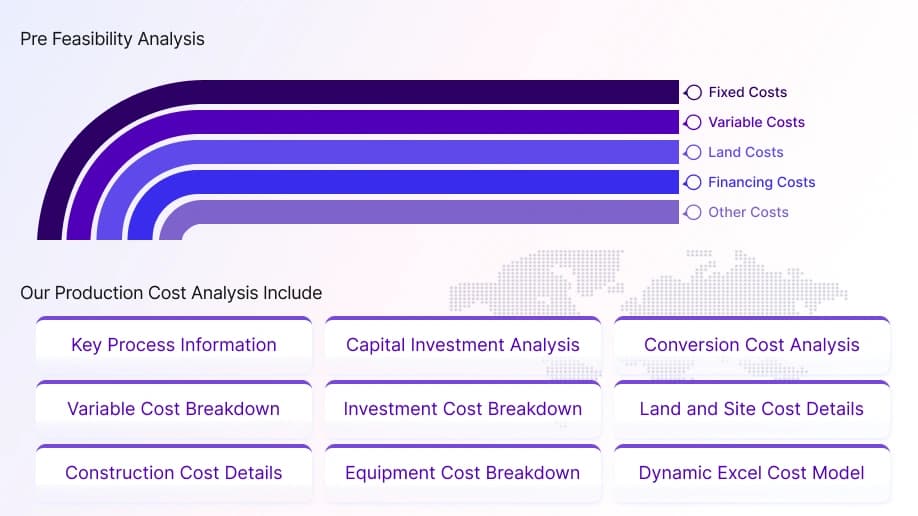
The report provides a detailed analysis essential for establishing a Niobium Carbide production plant. It encompasses all critical aspects necessary for Niobium Carbide production, including the cost of Niobium Carbide production, Niobium Carbide plant cost, Niobium Carbide production costs, and the overall Niobium Carbide production plant cost. Additionally, the study covers specific expenditures associated with setting up and operating a Niobium Carbide production plant. These encompass production processes, raw material requirements, utility requirements, infrastructure needs, machinery and technology requirements, manpower requirements, packaging requirements, transportation requirements, and more.
Niobium Carbide is recognized as an extremely hard refractory ceramic material that has a wide range of applications in various industries. It is widely utilized as a component or part used in the production of cutting tools, drills, grinding tools, and hard and protective coatings. Moreover, the compound is also utilized as a grain growth inhibitor in steel to enhance its toughness and strength. It is often utilized in making various wear-resistant parts that are used in the production of automotive components. Additionally, it is also employed in making various refractory materials that operate under extreme temperatures, such as furnaces, kilns, and various processing equipment.
The market for niobium carbide is predominantly driven by its application in tool bits for production parts that undergo abrasion, fretting, and particle erosion, such as cutting tools etc., which significantly boosts its demand in the production industry. Its utilization in making hard-face coatings for various wear-resistant parts for machining applications and wear protection further enhances its demand in the automotive and aerospace industries.
Additionally, its usage in the manufacture of high-strength, low-alloy (HSLA) steels with excellent hardness and weldability remarkably accentuates its demand in the construction industry. Furthermore, several factors influence industrial Niobium Carbide procurement, such as the availability of raw materials (Benzoic acid, etc.), cost and pricing, regulatory compliance, quality standards, technological advancements, environmental considerations, sustainability practices, distribution (including trading and shipping), logistics, safety standards, etc.
Raw Material for Niobium Carbide Production
According to the Niobium Carbide production plant project report, the major raw materials for Niobium Carbide production include Benzoic Acid-Lithium Hydroxide.
Production Process of Niobium Carbide
The extensive Niobium Carbide production cost report consists of the following industrial production process:
- Production from Ferroniobium: This method of production involves the use of its low-cost resource, ferroniobium, through mechanochemical and subsequent chemical separation methods at low temperatures, which results in the formation of niobium carbide as the product. The process produces NbC powders as well as metallic iron (Fe) from ferroniobium (FeNb) and graphite (C) powders by using a planetary mill at a milling speed greater than 600 rpm with a molar ratio of FeNb: C as a 1:1, followed the heating in argon gas to separate NbC and Fe. Further, the obtained NbC particles undergo leaching with hydrochloric acid to separate niobium carbide particles from mixed particles.
Niobium Carbide (NbC) is a form of 2D material that is also known as MXene. The molecular formula of the compound is Nb4C3, and its molecular weight is 104.917 g/mol. Moreover, the IUPAC name of the compound is niobium methanidylidenium. The compound has a cubic-F lattice and is among the hardest technical compounds known. Additionally, the compound appears as a green crystalline cubic structure that has a metallic luster. The density of the compound is 7.82g/cm3. Its melting point is 3490°C, and its boiling point is 4300°C.