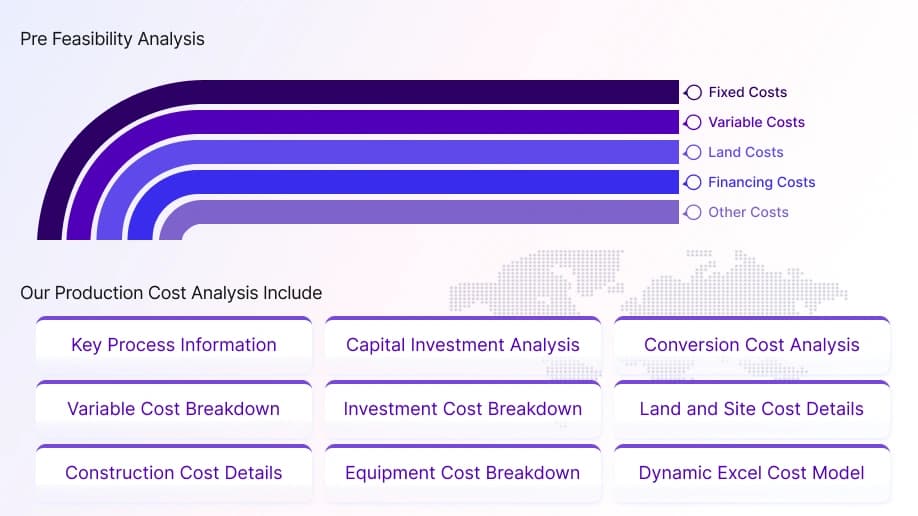
The report provides a detailed analysis essential for establishing a Norethisterone production plant. It encompasses all critical aspects necessary for Norethisterone production, including the cost of Norethisterone production, Norethisterone plant cost, Norethisterone production costs, and the overall Norethisterone production plant cost. Additionally, the study covers specific expenditures associated with setting up and operating a Norethisterone production plant. These encompass production processes, raw material requirements, utility requirements, infrastructure needs, machinery and technology requirements, manpower requirements, packaging requirements, transportation requirements, and more.
Norethisterone is a synthetic progestational hormone that finds a wide range of applications in the medical and pharmaceutical industries. It is widely utilized as an oral drug for the treatment of amenorrhea, functional uterine bleeding, and endometriosis and contraception. Moreover, it also finds its application as a medication for the treatment of secondary amenorrhea, submucous fibroids, abnormal uterine bleeding, and other issues associated with hormone imbalance. Additionally, it is also employed in combination with estrogen component as a hormone replacement therapy in the treatment of postmenopausal osteoporosis, hypoestrogenism, and moderate-to-severe vasomotor symptoms linked with menopause.
The market for Norethisterone is majorly driven by its broad usage in the medical and pharmaceutical industries as a synthetic oral contraceptive and a progestin, which significantly accentuates its market expansion. Its application in the treatment of amenorrhea, endometriosis, and other uterine disorders further enhances its demand in the medical and pharmaceutical industries.
Additionally, its employment as a combination drug for the treatment of vulvovaginal atrophy, postmenopausal osteoporosis, and other issues that arise in women after menopause remarkably accentuates its demand in the medical industry. Furthermore, several factors influence industrial Norethisterone procurement, such as the availability of raw materials (NORE-001, acetylene, etc.), cost and pricing, compliance with medical and pharmaceutical regulations, quality standards, technological advancements, environmental considerations, sustainability practices, distribution (including trading and shipping), logistics, safety standards, etc.
Raw Material for Norethisterone Production
According to the Norethisterone production plant project report, the major raw materials for Norethisterone production include 19-Nor-4-androstene-3 (NORE-001)- Trimethyl Orthoformate-Methanol- Acetylene- Hydrochloric Acid.
Production Process of Norethisterone
The extensive Norethisterone production cost report consists of the following industrial production process:
- Production from (NORE-001): This method of production is initiated by the reaction of 19-Nor-4-androstene-3 (NORE-001) with trimethyl orthoformate in the presence of MeOH to form the carbonyl protection product NORE-002. Further, NORE-002 is reacted with acetylene in the presence of KOtBu and acetone to obtain the alkyne NORE-003, followed by its deprotection in the presence of hydrochloric acid and THF, which results in the formation of norethindrone as the final product.
Norethisterone belongs to the class of 19-nortestosterone-derived class of progestins. It is classified as a second-generation progestin that is also known as norethindrone. The molecular formula of the compound is C20H26O2, and its molecular weight is 298.4 g/mol. Moreover, the IUPAC name of the compound is (8R,9S,10R,13S,14S,17R)-17-ethynyl-17-hydroxy-13-methyl-1,2,6,7,8,9,10,11,12,14,15,16-dodecahydrocyclopenta[a]phenanthren-3-one. The compound is also known as Norlutin or Norpregneninolone. Additionally, the melting point of the compound ranges between 202-204°C, and it is not soluble in water.