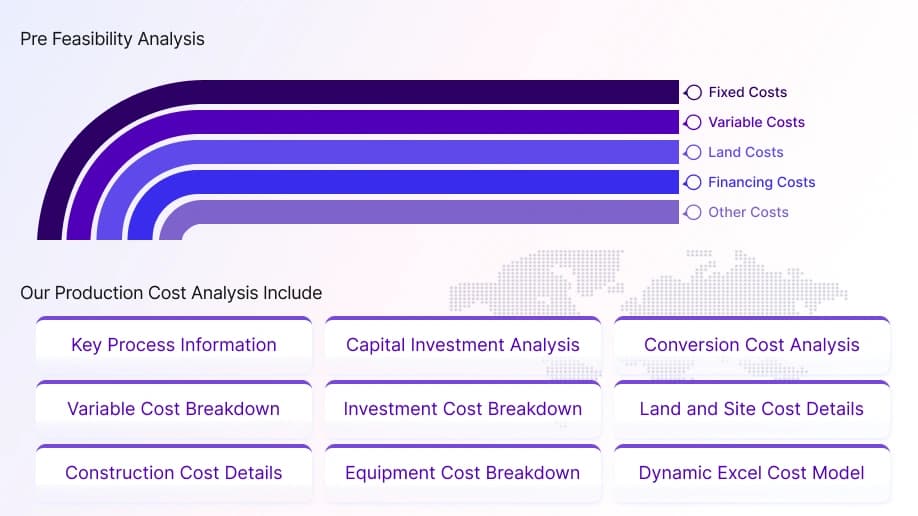
The report provides a detailed analysis essential for establishing a Polyacrylonitrile (PAN) production plant. It encompasses all critical aspects necessary for Polyacrylonitrile production, including the cost of Polyacrylonitrile production, Polyacrylonitrile plant cost, Polyacrylonitrile (PAN) production costs, and the overall Polyacrylonitrile production plant cost. Additionally, the study covers specific expenditures associated with setting up and operating a Polyacrylonitrile production plant. These encompass production processes, raw material requirements, utility requirements, infrastructure needs, machinery and technology requirements, manpower requirements, packaging requirements, transportation requirements, and more.
Polyacrylonitrile, or PAN, is a very versatile polymer that has many uses in industries because of its physical characteristics. PAN is used for production carbon fiber, which is widely used in aerospace and automotive industry for the fabrication of lightweight and high-strength composite material. PAN fibers are widely used in the textile industry for their high tensile strength, chemical resistance, and colour fastness, as well as for their high endurance for performance fabrics used in apparel and industrial textiles. Further, PAN finds its application in the medical field, where it is incorporated into medical textiles, implantable devices, and wound care products on account of its biocompatibility besides possessing a very high strength-to-weight ratio. There are also other uses, such as it being used in filtration membranes and other uses as a component in different chemical processes.
The market for Polyacrylonitrile is driven by its application as a precursor for carbon fibre production, which elevates its demand in the aerospace and automotive industries. Its high tensile strength, chemical resistance, and color retention amplifies its demand in the textile industry. The compound’s biocompatibility and strength-to-weight ratio are utilized in medical textiles and implantable devices, which fuels its market growth in the medical industries. Its usage in filtration membranes boosts its demand for water treatment. Overall, industrial Polyacrylonitrile procurement is influenced by its application in various industries such as the aerospace and automotive industries, the textile industry, the medical industry, along with the availability of its raw material (acrylonitrile), the cost of its raw material, logistics and distribution, and regulatory approvals.
Raw Material for Polyacrylonitrile (PAN) Production
According to the Polyacrylonitrile production plant project report, the key raw material used in the production of Polyacrylonitrile includes acrylonitrile.
Production Process of Polyacrylonitrile (PAN)
The extensive Polyacrylonitrile production cost report consists of the following major industrial production process:
- Production from polymerization of acrylonitrile: The production process of Polyacrylonitrile takes place by aqueous dispersion polymerization process. The process involves the polymerization of acrylonitrile with comonomers such as methyl acrylate to produce the polymer, Polyacrylonitrile, which is converted to fiber through wet spinning.
Polyacrylonitrile (PAN) with the formula (C3H3N)n is a synthetic resin made by acrylonitrile polymerization. It is an important member of the acrylic resin family. It has a nitrile (CN) functional group attached to the polyethylene backbone as the unit structure. The polymer has unique properties, like being resistant to degradation caused by ultraviolet rays, most organic solvents, and acids, as well as breakage; they are soft, comfortable, and offer thermal insulation. It looks like a white solid but might change to a yellowish or black color based on temperature. It has a density of 1,184 g/cm³. Its temperature of fusion and glass transition is over 300ºC and around 95ºC, respectively. It degrades upon boiling, and it is insoluble in water.