
Udeesha Tomar
AVP - Strategy and Solutions
Leading procurement research solutions across chemicals, materials, and food & beverages, with expertise in price forecasting and market analytics.
Last Updated: October, 2026

Trusted by 200+ Clients
The report provides a detailed analysis essential for establishing a Petroleum Jelly production plant. It encompasses all critical aspects necessary for Petroleum Jelly production, including the cost of Petroleum Jelly production, Petroleum Jelly plant cost, Petroleum Jelly production costs, and the overall Petroleum Jelly production plant cost. Additionally, the study covers specific expenditures associated with setting up and operating a Petroleum Jelly production plant. These encompass production processes, raw material requirements, utility requirements, infrastructure needs, machinery and technology requirements, manpower requirements, packaging requirements, transportation requirements, and more.
Petroleum Jelly is a mixture of hydrocarbons mainly utilized in medical and pharmaceutical applications as a protective dressing and to substitute fats in cosmetics and ointments. In addition, it finds use in many kinds of modelling clay, polishes, lubricating greases, and rust preventives. In personal care and cosmetic products, it finds use as an important ingredient in several moisturizers, baby care, conditioners, and lip balms, among others. Also, it is used in making Vaseline and other popular products like Aquaphor, Neosporin, bag balm, etc.
The market for Petroleum Jelly is majorly driven by its application in various industries such as cosmetics, personal care, medical, pharmaceutical, telecommunications, food, and rubber industries. Its utilization in cosmetics formulations, skincare products, lotions, and hair care products, due to its moisturizing and protective properties, elevates its demand in the cosmetics, skincare, and personal care industries. Its usage in ointments and topical treatments boosts its market growth in the pharmaceutical and medical industries.
Its function as a cable-filling compound in the telecommunications sector fuels its market expansion. Its role as a lubricant and mold release agent in rubber production and food processing also contributes to its market growth. Innovations in product formulations and production processes to enhance the quality and functionality of Petroleum Jelly make it more appealing to manufacturers and consumers, which further impacts industrial Petroleum Jelly procurement.
According to the Petroleum Jelly production plant project report, the key raw material used in the production of Petroleum Jelly includes crude oil.
The extensive Petroleum Jelly production cost report consists of the following major industrial production process:
Petroleum Jelly or petrolatum is a combination of mineral oils and waxes that form a semisolid jelly-like substance. Chemically, it's a hydrocarbon mix, mainly the paraffin series. Petrolatum is a gel-like substance derived as a petroleum by-product, a derivative of crude oil. It looks like a translucent, yellow-amber, or whitish gel with no taste or odor. Its melting point is around the human body temperature (37 °C). It has a density of 0.84 g/cm3. It's insoluble in water but has a solubility in dichloromethane, carbon disulfide, benzene, chloroform, diethyl ether, and oil of turpentine. Its respective melting, boiling, and flash points are 70-80 °C, 322 °C, and 198 °C.
Petroleum Jelly Production Cost Report
Choose What's Right for You
Pay Via



| Particulars | Details |
|---|---|
| Product Name | Petroleum Jelly |
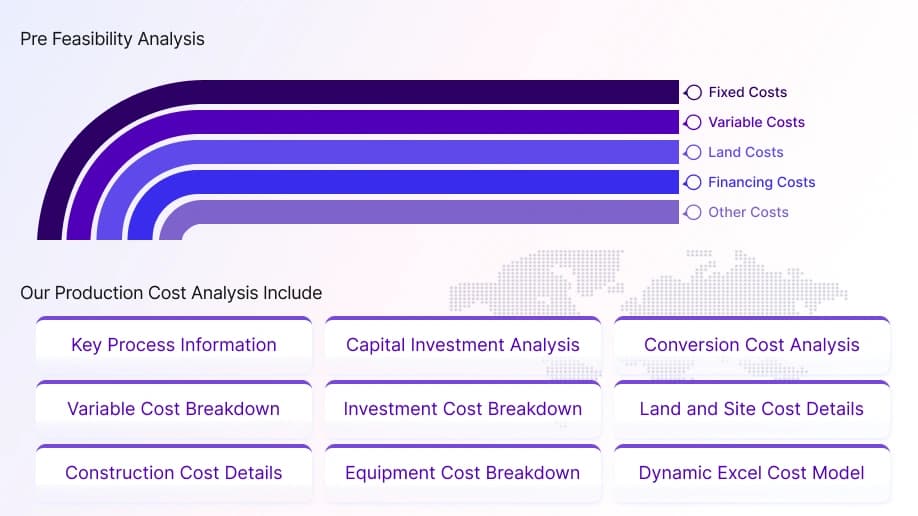
| Scope | Production Process: Process Flow, Material Flow, Material Balance Raw Material and Product Specifications: Raw Material Consumption, Product and Co-product Generation Land and Site Cost: Offsites/Civil Works, Equipment Cost, Auxiliary Equipment Costs, Contingency, Engineering and Consulting Charges, Working Capital Variable Cost: Raw Material, Utilities, Other Variable Costs Fixed Cost: Labor Requirements and Wages, Overhead Expenses, Maintenance Charges, Other Fixed Costs Financing Costs: Interest on Working Capital, Interest on Loans Other Costs: Depreciation Charges, General Sales and Admin Cost |
| Currency | US$ (Data can also be provided in the local currency) | Customization Scope | The report can be customized as per the requirement of the customer |
| Post-Sale Analysts Report | 10-12 weeks of post-purchase analyst support after report delivery for any queries from the deliverable |
| Delivery Format | PDF and Excel format through email (editable version in PPT/Word format of the report can be also provided on special request) |
Petroleum Jelly Production Cost Processes with Cost Analysis
This study analyzes Petroleum Jelly Production from Crude Oil, covering manufacturing, process flow, operating expenses, and financial considerations.
At Procurement Resource, we not only focus on optimizing the should cost of production for Petroleum Jelly but also provide our clients with extensive intel and rigorous information on every aspect of the production process. By utilizing a comprehensive cost model, we help you break down expenses related to raw materials, labor, and technology, offering clear pathways to savings. We also assist in evaluating the capital expenditure (CAPEX) and operating expenses (OPEX), which are often measured as cost per unit of production, such as USD/MT, ensuring that your financial planning is aligned with industry benchmarks.
We offer valuable insights on the top technology providers, in-depth supplier database, and best manufacturers, helping you make informed decisions to improve efficiency. Additionally, we design the most feasible layout for your production needs, ensuring the entire process runs smoothly. By minimizing the cash cost of production, we ensure that you stay competitive while securing long-term profitability in the growing Petroleum Jelly market. Partnering with Procurement Resource guarantees that every aspect of your production is cost-efficient, advanced, and tailored to your specific requirements.
AVP - Strategy and Solutions
Leading procurement research solutions across chemicals, materials, and food & beverages, with expertise in price forecasting and market analytics.
Need more help?

Still Need Help?
Compare & Choose the Right Report Version for You
How to Order Your Report?