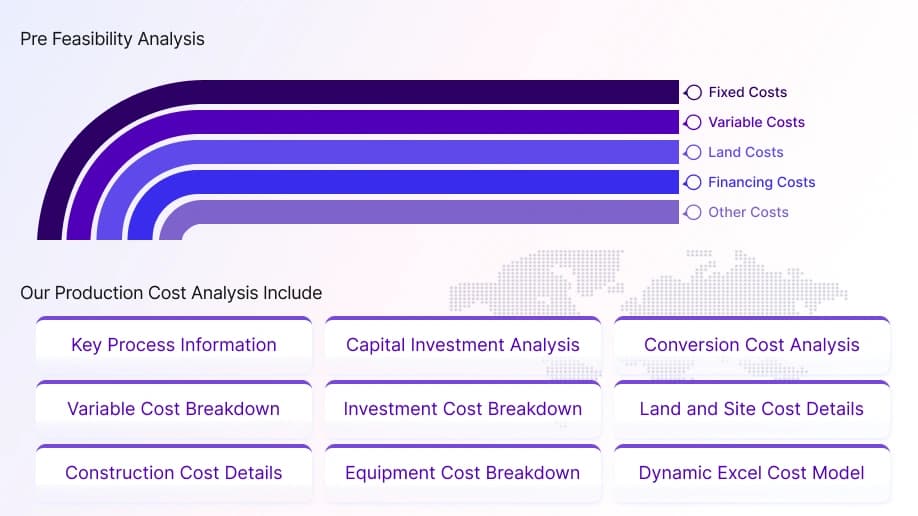
The report provides a detailed analysis essential for establishing a Polyvinyl Chloride production plant. It encompasses all critical aspects necessary for Polyvinyl Chloride production, including the cost of Polyvinyl Chloride production, Polyvinyl Chloride plant cost, Polyvinyl Chloride production costs, and the overall Polyvinyl Chloride production plant cost. Additionally, the study covers specific expenditures associated with setting up and operating a Polyvinyl Chloride production plant. These encompass production processes, raw material requirements, utility requirements, infrastructure needs, machinery and technology requirements, manpower requirements, packaging requirements, transportation requirements, and more.
Polyvinyl chloride (PVC) is a thermoplastic polymer used in various industries due to its durability and adaptability. In construction, rigid PVC is utilized for pipes, window frames, and siding, while in packaging, it serves as a material for bottles and cling films. The medical sector employs medical-grade PVC for devices like blood bags and tubing due to its non-toxic properties. Additionally, PVC is used for electrical insulation, synthetic leather in textiles, signage, and graphics, and automotive components such as interior trims.
The market for Polyvinyl Chloride is driven by its usage for pipes, fittings, window frames, and flooring materials, which elevates its demand in the construction industry. Its usage for devices like blood bags and tubing amplifies its market in the medical and healthcare industries. Its utilization in various sectors, such as electrical insulation, synthetic leather in textiles, signage, and graphics, and automotive components, such as interior trims, boosts its demand even more. Overall, industrial Polyvinyl Chloride procurement is influenced by its application in various industries such as construction, medical, healthcare, electronic, textile, and automotive industries, the availability of its raw materials (salt, petroleum, and vinyl chloride), the cost of its raw materials, technological advancements, sustainability trends, and regulatory approvals.
Raw Material for Polyvinyl Chloride Production
According to the Polyvinyl Chloride production plant project report, the key raw materials used in the production of Polyvinyl Chloride include salt-petroleum; vinyl chloride.
Production Process of Polyvinyl Chloride
The extensive Polyvinyl Chloride production cost report consists of the following major industrial production processes:
- Production via salt and petroleum: The production process of Polyvinyl Chloride involves salt and petroleum as the starting materials. In this process, salt (sodium chloride) undergoes electrolysis to produce chlorine gas. Petroleum is refined to form naphtha, which is cracked to yield ethylene. Ethylene and chlorine are combined to form vinyl chloride monomer (VCM). Finally, VCM monomers are polymerized to form Polyvinyl Chloride (PVC). The raw PVC can then be modified with additives to enhance the properties of PVC.
- Production via polymerization: The production process of Polyvinyl Chloride occurs via the polymerization of vinyl chloride via any of the three methods: suspension polymerization, emulsion polymerization, and bulk polymerization to produce Polyvinyl Chloride.
Polyvinyl Chloride is a synthetic resin and a thermoplastic polymer. It is abbreviated as PVC. It is the third most produced synthetic plastic polymer globally. By polymerizing vinyl chloride monomer, PVC is created (VCM). The first stage of polymerization involves pressing and liquifying raw VCM material. In a polymerization reactor, where it is treated later, it is combined with water and suspending agents. Finally, it is injected into a different reactor to make PVC at a temperature between 40 and 60 degrees.
PVC produced at the end of the process is suspended in water as slurry-like particles with a diameter of 50 to 200 um. It is a lightweig ht, sturdy, and abrasion-resistant material in nature. It is white, brittle solid in appearance. It is immiscible in water. The chemical formula of polyvinyl chloride is (C2H3Cl) n, and its melt temperature ranges between 212 - 500 °F (100 - 260°C). The Heat Deflection Temperature (HDT) of PVC is 92 °C (198 °F) and its specific gravity ranges between 1.35-1.45.