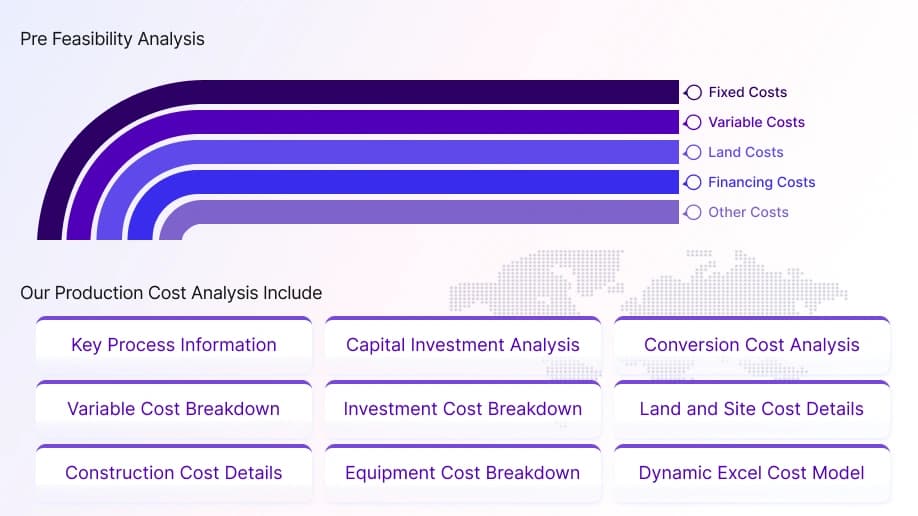
The report provides a detailed analysis essential for establishing a Propofol production plant. It encompasses all critical aspects necessary for Propofol production, including the cost of Propofol production, Propofol plant cost, Propofol production costs, and the overall Propofol production plant cost. Additionally, the study covers specific expenditures associated with setting up and operating a Propofol production plant. These encompass production processes, raw material requirements, utility requirements, infrastructure needs, machinery and technology requirements, manpower requirements, packaging requirements, transportation requirements, and more.
Propofol is an anesthetic agent that is widely used in the initiation and maintenance of general anesthesia. It works by increasing the effects of a natural brain chemical that helps calm the brain and nervous system. Propofol is quick and takes about 40 seconds to work, making it very useful in medical settings that need fast sedation. It is extensively used as a general anesthesia and procedural sedation as it provides smooth recovery and low chances of postoperative nausea.
It is utilized in ICU sedation as it is effective and cost-efficient in comparison to other options. Propofol is also found to manage prolonged seizures in patients experiencing refractory status epilepticus. It has also shown its effectiveness as a sleep aid for critically ill patients. Its combination with other formulations can also be used for better sedation during various procedures.
The Propofol market is driven by it being a very popular product in the anesthesia category. Its varied applications, ranging from general anesthesia to the controlling of refractory status epilepticus and helping critically ill patients to aid sleep, contributes to its high demand. Its smooth incorporation and recovery profile makes it a preferred choice for general anesthesia, procedural sedation, monitored anesthesia care, and ICU sedation. Propofol is flexible and cost-effective option in comparison to other sedatives, making it a popular anesthetic compared to others. The changes in its demand as an anesthetic agent in various applications, along with its production prices, market prices, and logistics, directly influence industrial Propofol procurement across the world.
Raw Material for Propofol Production
According to the Propofol production plant project report, the key raw materials used in the production of Propofol include phenol, propylene, and an acid catalyst.
Production Process of Propofol
The detailed Propofol production cost report consists of the following major industrial production process:
- From phenol and propylene: The industrial synthesis of propofol (2,6-diisopropylphenol) begins with the alkylation of phenol using propylene in the presence of an acid catalyst. This Friedel-Crafts reaction selectively attaches two isopropyl groups to the phenol ring. The resulting crude propofol is then purified through vacuum distillation. Finally, the pure compound is formulated into the injectable, milky-white emulsion used in clinics by emulsifying it with soybean oil, glycerol, and egg lecithin.
Propofol’s chemical name is 2,6-diisopropylphenol, and it is milky white in appearance. It has a mild phenolic odor at 100% concentration. Its molecular formula is C12H18O and a molecular weight of 178.27. It is slightly soluble in water. It has a melting point of 18°C and a boiling point of 256°C. It has a refractive index of 1.514, and its flash point is greater than 230°F. Its injectable emulsion is isotonic, having a pH range of 6.0 to 8.5. It is stored in nitrogen to prevent oxidation. These physical and chemical properties collectively contribute to its applications as an anesthetic agent.