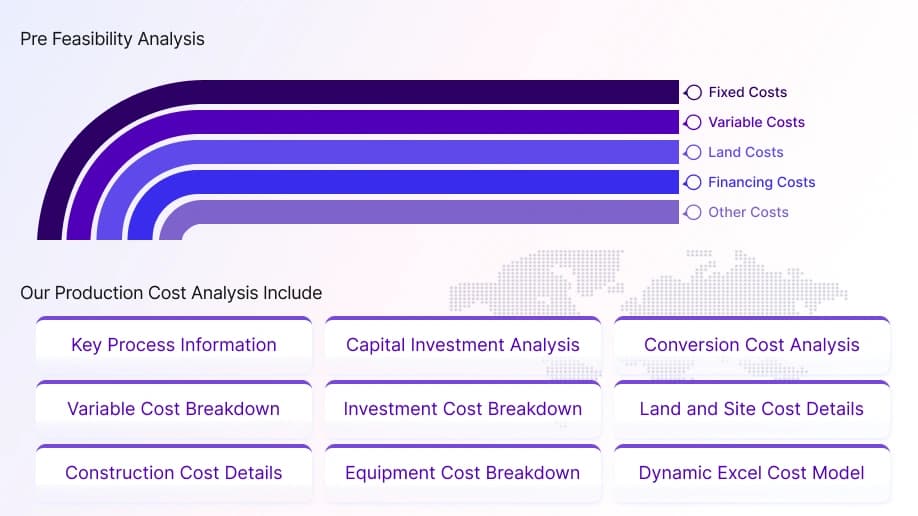
The report provides a detailed analysis essential for establishing a Risperidone production plant. It encompasses all critical aspects necessary for Risperidone production, including the cost of Risperidone production, Risperidone plant cost, Risperidone production costs, and the overall Risperidone production plant cost. Additionally, the study covers specific expenditures associated with setting up and operating a Risperidone production plant. These encompass production processes, raw material requirements, utility requirements, infrastructure needs, machinery and technology requirements, manpower requirements, packaging requirements, transportation requirements, and more.
Risperidone is a medication that helps people with certain mental health problems. It is used to manage symptoms like hallucinations, delusions, and disorganized thinking related to schizophrenia. It is utilized in the treatment of manic episodes associated with bipolar disorder by stabilizing mood and reducing the intensity of these symptoms. Risperidone is utilized in managing irritability and aggression in children and adolescents with autism spectrum disorders and helps in improving their social behavior and temper. It can also be used to treat irritability and aggression in children and adolescents with autism spectrum disorders and provides a calming effect.
The market for Risperidone is driven by several factors. Its use in managing symptoms of schizophrenia contributes to its growing demand. Its utilization in stabilizing mood in bipolar disorder, as well as its use in managing autism-related problems in children and teenagers, makes it a popular medication in the clinical field. Its use to manage irritation and aggression in individuals having autism further contributes to its demand. Thus, industrial Risperidone procurement is influenced by its usage in treating schizophrenia, bipolar disorder, and autism, along with technological advancements, rising healthcare expenditure, and greater awareness of mental health issues.
Raw Material for Risperidone Production
According to the Risperidone production plant project report, the key raw materials used in the production of Risperidone include (1-Acetylpiperidone-4-Carbonyl Chloride)-(2,4-Difluorobenzene)-Hydroxylamine-Pyridopyrimidine Derivative.
Production Process of Risperidone
The extensive Risperidone production cost report consists of the following major industrial production process:
- From 1-Acetylpiperidone-4-Carbonyl Chloride, (2,4-Difluorobenzene), Hydroxylamine, and Pyridopyrimidine Derivative: The production process for Risperidone involves several key steps. First, 1-acetylpiperidone-4-carbonyl chloride and 2,4-dichlorobenzene react with each other, forming an intermediate. This intermediate then goes through hydrolysis and converted to its oxime by using hydroxylamine. The fluorine atom is displaced, and this compound reacts with a pyridopyrimidine derivative, forming Risperidone.
Risperidone is a white-colored solid. Its molecular formula is C23H27FN4O2, and it has a molecular mass of 410.48 g/mol. It is insoluble in water but soluble in methylene chloride, methanol, and hydrochloric acid. Its melting point is about 170°C, and its bioavailability is around 70%. It is metabolized in the liver into its active metabolite, 9-hydroxy Risperidone. It has high protein binding of around 88% and around 77% for its metabolite. Its elimination half-life is around 20 hours in oral dosage while 3-6 days by injections. These physical and chemical properties contribute to its pharmacological applications.