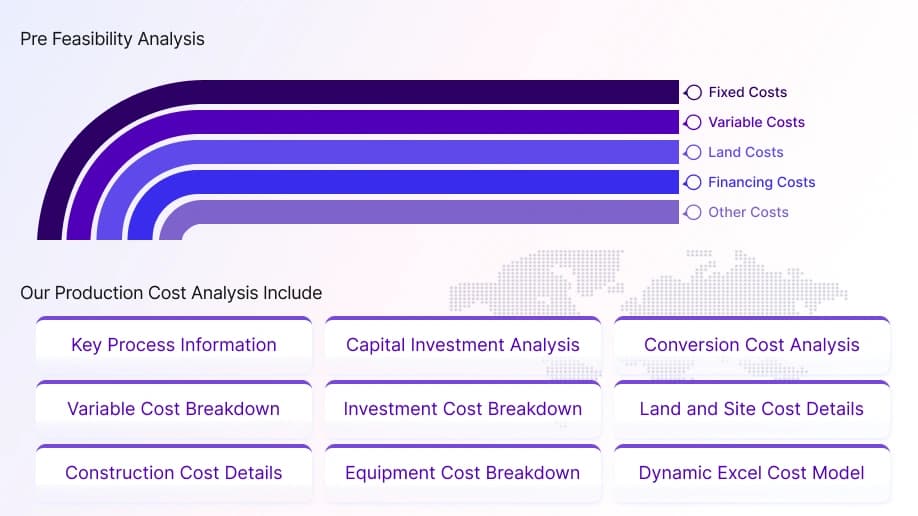
The report provides a detailed analysis essential for establishing a Rituximab production plant. It encompasses all critical aspects necessary for Rituximab production, including the cost of Rituximab production, Rituximab plant cost, Rituximab production costs, and the overall Rituximab production plant cost. Additionally, the study covers specific expenditures associated with setting up and operating a Rituximab production plant. These encompass production processes, raw material requirements, utility requirements, infrastructure needs, machinery and technology requirements, manpower requirements, packaging requirements, transportation requirements, and more.
Rituximab is a monoclonal antibody medication that has been proven effective in treating types of cancers and autoimmune disorders. It is accepted in the treatment of several hematological malignancies, namely non-Hodgkin lymphoma (NHL), Waldenström's macroglobulinemia, nodular lymphocyte predominant Hodgkin's lymphoma, and chronic lymphocytic leukemia (CLL). Rituximab targets a specific protein called CD20 on the surface of B cells, which helps to destroy those cells by triggering a process that involves the immune system and the complement system.
It is also found effective in treating autoimmune diseases like pemphigus vulgaris, rheumatoid arthritis, microscopic polyangiitis, granulomatosis with polyangiitis, myasthenia gravis, and idiopathic thrombocytopenic purpura by getting rid of the harmful B cells; Rituximab has been shown to improve the symptoms and course of these autoimmune diseases greatly. Apart from blood cancers and autoimmune disorders, there is ongoing research for Rituximab in treating other dermatological, neurological, and renal autoimmune disorders.
The market for Rituximab is driven by its proven efficiency across a range of medicinal areas. Rituximab has significant success in treating hematological cancers, such as non-Hodgkin lymphoma (NHL), Waldenström's macroglobulinemia, nodular lymphocyte predominant Hodgkin's lymphoma, and chronic lymphocytic leukemia (CLL). Also, its ability to manage an array of autoimmune disorders, such as pemphigus vulgaris, rheumatoid arthritis, microscopic polyangiitis, granulomatosis with polyangiitis, myasthenia gravis, and idiopathic thrombocytopenic purpura.
Rituximab's potential to be used in treating disorders like dermatological, neurological, and renal autoimmune disorders further increases the demand. Hence, the changes in its demand in the medical area for the treatment of cancers and autoimmune disorders and its potential in treating other disorders, along with its production prices, market prices, and logistics, directly influence industrial Rituximab procurement in the market across the world.
Raw Material for Rituximab Production
According to the Rituximab production plant project report, the key raw materials used in the production of Rituximab include Mice, Myeloma cells, CHO cells, CD20 antigen, cell culture media, chromatography resins, and sterile diluents.
Production Process of Rituximab
The extensive Rituximab production cost report consists of the following major industrial production process:
- From Mice, myeloma cells, CHO cells, CD20 antigen, cell culture media, chromatography resins, and sterile diluents: For the industrial production of Rituximab, multiple steps are required. First, a special type of cell that produces antibodies targeting the CD20 protein is created by the researchers. It is done by injecting mice with CD20 causing the mice to make antibodies against it. Then, the antibody-producing cells from the mice are fused with immortal cells to make hybridomas cells. After that, those hybridoma cells are selected that make the desired anti-CD20 antibody.
In the next step, the cells are grown in large tanks, and Chinese hamster ovary (CHO) cells are used for producing antibodies in large quantities. After the cell growth, the rituximab antibody is separated from other cell components by using chromatography. The extracted Rituximab is finally mixed with a sterile solution and transferred into single-use vials to be packaged and distributed. The entire process is performed in a very sterile and safe environment, and extensive testing is done at every step, to manufacture high-quality, safe, and effective Rituximab.
Rituximab is a genetically obtained monoclonal antibody that targets the CD20 antigen expressed on the surface of normal and malignant B lymphocytes. The molecular weight of the whole rituximab antibody is approximately 144-150 kDa, and its melting point is 71°C. Rituximab exhibits high solubility, with a solubility greater than 10 mg/mL, and its isoelectric point (pI) ranges from 9.29 ± 0.01 to 9.42 ± 0.00, with the main isoform having a pI around 9.01 ± 0.08.