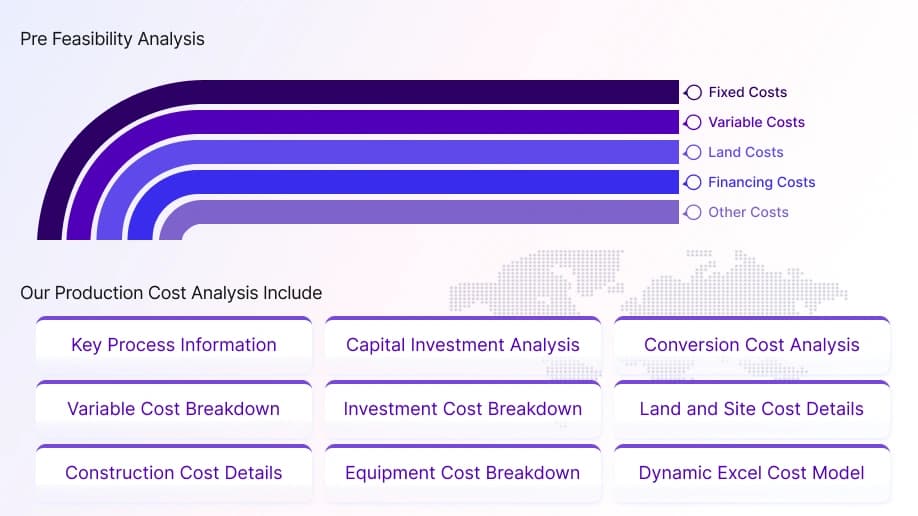
The report provides a detailed analysis essential for establishing a Rivaroxaban production plant. It encompasses all critical aspects necessary for Rivaroxaban production, including the cost of Rivaroxaban production, Rivaroxaban plant cost, Rivaroxaban production costs, and the overall Rivaroxaban production plant cost. Additionally, the study covers specific expenditures associated with setting up and operating a Rivaroxaban production plant. These encompass production processes, raw material requirements, utility requirements, infrastructure needs, machinery and technology requirements, manpower requirements, packaging requirements, transportation requirements, and more.
Rivaroxaban is an anticoagulant medication used in treating and preventing blood clots. It acts by blocking the activity of factor Xa, the clotting protein, that decreases thrombin levels and stops clot formation. It is used to inhibit stroke in individuals having non-valvular atrial fibrillation. Rivaroxaban treats deep vein thrombosis (DVT) and pulmonary embolism (PE) in individuals that experience recurrence after initial treatment. It also restraints DVT and PE in patients that recently had their hip, or knee replacement surgery, or those who are at risk due to decreased mobility. It is used in combination with aspirin to lower the chances of heart attack or stroke in elderly individuals having coronary artery disease or peripheral arterial disease. It comes in the list of WHO's essential medicines.
The procurement of Rivaroxaban is driven by several key factors. It is an effective anticoagulant therapy to prevent strokes and blood clots making it popular in clinical treatments. It's used to prevent vein thrombosis (DVT) and pulmonary embolism (PE) in patients who are at risk of stroke or heart attack due to immobilization or any recent surgery, making it a sought-after product. It is better than traditional anticoagulants, making it a preferred choice among healthcare providers. It is on WHO's list of essential medicines, making it a sought-after medication all over the world. Hence, its demand as an anticoagulant medication, along with its production prices, market prices, and logistics, directly influences industrial Rivaroxaban procurement across the globe.
Raw Material for Rivaroxaban Production
According to the Rivaroxaban production plant project report, the key raw materials used in the production of Rivaroxaban include (2-(Phenylamino) ethan-1-ol)-Chloroacetyl Chloride-Sodium Hydroxide-Ethanol-Nitric Acid-Sulfuric Acid-Palladium-Methanol-Epoxide-Carbonyldiimidazole-Tetrahydrofuran-Methylamine-Chlorothiophene Carboxylic Acid-Thionyl Chloride-Potassium Carbonate.
Production Process of Rivaroxaban
The extensive Rivaroxaban production cost report consists of the following major industrial production process:
- From 2-(Phenylamino) ethan-1-ol, Chloroacetyl Chloride, Sodium Hydroxide, Ethanol, Nitric Acid, Sulfuric Acid, Palladium, Epoxide, Carbonyldiimidazole, Tetrahydrofuran, Methylamine, Chlorothiophene Carboxylic Acid, Thionyl Chloride, and Potassium Carbonate: The production process for Rivaroxaban is a multi-step process. First, 2-(Phenylamino) ethan-1-ol is reacted with chloroacetyl chloride in the presence of sodium hydroxide and ethanol, forming a morpholine ring. This compound is then nitrated using nitric and sulfuric acids. After that, the nitro group is reduced to an amine by hydrogenation with palladium as a catalyst. This compound is further reacted with an epoxide in refluxing methanol to open the epoxide ring. After that, it goes through cyclization with carbonyldiimidazole in tetrahydrofuran, displacing the imidazole group with methylamine. Finally, it is coupled with chlorothiophene carboxylic acid using thionyl chloride in toluene, treated with potassium carbonate forming Rivaroxaban. After purification, the final product obtained is Rivaroxaban.
Rivaroxaban is a white to off-white crystalline powder. It has a molecular formula of CHClNOS and a molecular weight of 435.9 g/mol. It is slightly soluble in water but more soluble in organic solvents. It has a melting point of 228-229°C. It has a log P value of 2.5, making it moderately lipophile. It has a topological polar surface area of 116 Ų. It works as a direct inhibitor of factor Xa, reducing the risk of thromboembolic events. These physical and chemical properties make it an effective anticoagulant medication to be used in various applications.