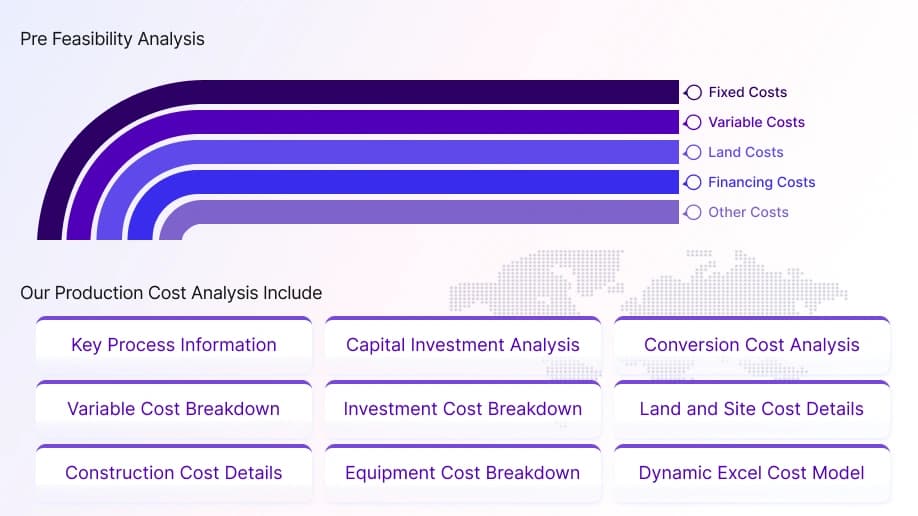
The report provides a detailed analysis essential for establishing a samarium production plant. It encompasses all critical aspects necessary for samarium production, including the cost of samarium production, samarium plant cost, samarium production costs, and the overall samarium production plant cost. Additionally, the study covers specific expenditures associated with setting up and operating a samarium production plant. These encompass production processes, raw material requirements, utility requirements, infrastructure needs, machinery and technology requirements, manpower requirements, packaging requirements, transportation requirements, and more.
Samarium is a rare earth metal variety with a shiny silver luster. The metal is majorly associated with metallurgical and optical operations. It serves as a component to be used to dope calcium chloride crystals, which are then utilized for optical lasers.
Samarium possesses high magnetic strength, and hence is used to produce magnets. Similarly, it is combined with other metal varieties, such as cobalt, etc., to produce magnets on a large scale. Moreover, it is used in infrared-absorbing glass and neutron absorbers that are used in nuclear reactors for power generation. Samarium oxide derived from samarium metal is included in glass and ceramic products.
The market for samarium is driven by its wide-scale applications in metal and optical operations. Its usage in chemical synthesis of its derivatives, such as samarium oxide, which has further usage in ceramic and glass production, propels the demand for samarium in the market. Moreover, its usage in magnets production, optical lasers, and more strengthens its market growth while increasing its demand in the global market. Industrial samarium procurement is influenced by its demand in the metal and other commercial operations. The variations in its demand, along with its market prices, production cost, logistics, and supply altogether, impact the procurement of samarium on a large scale.
Raw Material for Samarium Production
According to the samarium production plant project report, the key raw material for samarium production includes bastnasite mineral ore.
Production Process of Samarium
The extensive samarium production cost report consists of the major industrial production process:
- By Metallothermic Reduction: The production of samarium metal is carried out by extraction from the bastnasite mineral ore. The ore is processed through the liquid-liquid ion exchange method to separate and purify the metal oxide, i.e., samarium oxide, from the ore. The metal oxide is then subjected to metallothermic reduction, followed by distillation to obtain samarium at the end.
Samarium is a very popular chemical element that belongs to the lanthanide series of the periodic table. It is a silvery metal that is generally hard and can slowly oxidize in the atmosphere. One of the rare earth metals, samarium, can be obtained by mining natural ores like the mineral monazite and bastnasite.
The third most flammable lanthanide, after ytterbium and europium, is samarium. Samarium is made using electrolysis, reduction, and solvent extraction. The lanthanum is used to decrease the samarium oxide during the reduction process. The end result of the process is distilled to recover samarium while discarding lanthanum.
The atomic number of samarium is 62, and its atomic mass is 150.35 g mol -1. The electronegativity of samarium, according to Pauling, is 1.2. The density of samarium is 6.9 g.cm-3 at 20°C, and its electronic configuration is [ Xe] 4f6 6s2. The boiling point and melting point of samarium are 1790°C and 1072°C. It is a silvery white metal in appearance. When heated over 150° C, it ignites and develops an oxide layer in moist air, but it is generally stable at room temperature in dry air. Samarium has a rather stable oxidation state, similar to europium.