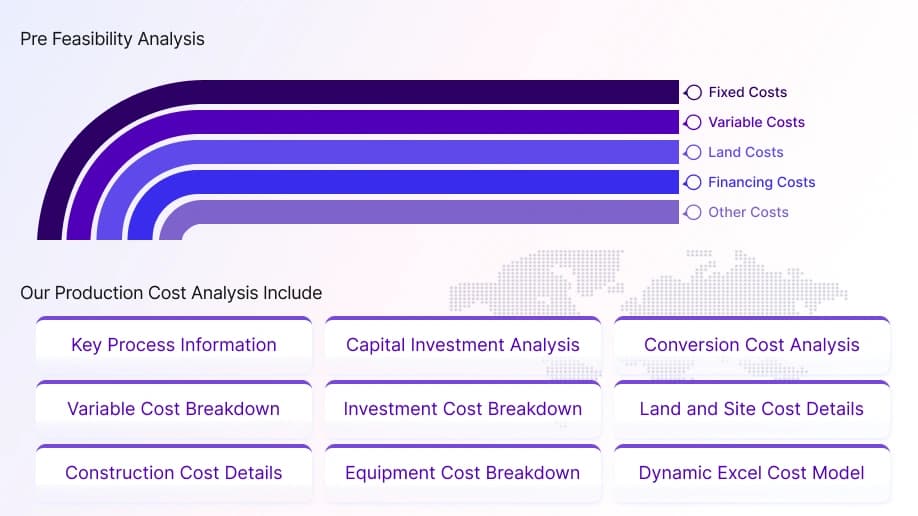
The report provides a detailed analysis essential for establishing a Silybin production plant. It encompasses all critical aspects necessary for Silybin production, including the cost of Silybin production, Silybin plant cost, Silybin production costs, and the overall Silybin production plant cost. Additionally, the study covers specific expenditures associated with setting up and operating a Silybin production plant. These encompass production processes, raw material requirements, utility requirements, infrastructure needs, machinery and technology requirements, manpower requirements, packaging requirements, transportation requirements, and more.
Silybin or Silibinin is a compound that is widely recognized for its health benefits. It is widely used in the treatment of hepatitis and liver cirrhosis. Moreover, it also finds its application in the treatment of liver injury that is induced by a drug or a chemical. Additionally, it is often employed as an anti-cancer agent for the treatment of prostate, skin, breast, colon, lung, bladder, and hepatocellular carcinoma (HCC).
The demand for Silybin is mainly driven by its extensive applications in the medical and pharmaceutical industries as a hepatoprotectant, which significantly promotes its market expansion. Moreover, its employment as a hepatoprotectant in patients with acute and chronic liver injury further enhances its demand in the medical and pharmaceutical industries.
Its employment in the treatment of hepatitis and its action against various cancer cells, including prostate, bladder, and hepatocellular carcinoma (HCC), effectively promotes its market growth. Furthermore, several critical factors, including the availability, purity, and cost of raw materials like Streptomyces conglobeatus, adherence to regulatory and quality standards, supplier relationships, efficient distribution, and logistics, and the effect of technological advancements, globally influence industrial Silybin procurement to a large extent.
Raw Material for Silybin
According to the Silybin production plant project report, the major raw material for Silybin production includes Silybum marianum Gaertn (Milk Thistle).
Production Process of Silybin
The extensive Silybin production cost report consists of the following industrial production process:
- Production from Milk Thistle Plant: This method of production involves the use of dried fruit of Silybum marianum Gaertn to obtain silybin as the product. The process is initiated by the separation of fatty oils from it, followed by extracting the remaining solid residue with ethyl acetate and evaporating it. Further, the dry residue is dissolved in a solvent mixture, including methanol, water, and petroleum ether, to form a two-phase system, followed by subjecting the same to multiple counter-current contact with petroleum ether, which results in the formation of polyhydroxyphenyl chromanone or silybin from the lower phase.
Silybin is an active component of silymarin flavonoids isolated from the milk thistle plant Silybum marianum. The molecular formula of the compound is C25H22O10, and its molar mass is 482.4 g/mol. Moreover, the melting point and the boiling point of the compound are 164-174°C and 793.0°C, respectively. The density of the compound is 1.527 g/cm3, and the value of its dissociation constant pka= 6.42±0.04. It appears as a pale yellow solid whose solubility in water is 54mg/L(24.99 ºC). Additionally, the compound is generally stable but is incompatible with strong oxidizing agents and strong bases, and it is stored at -20°C. The compound is marketed under the trade name Legalon.