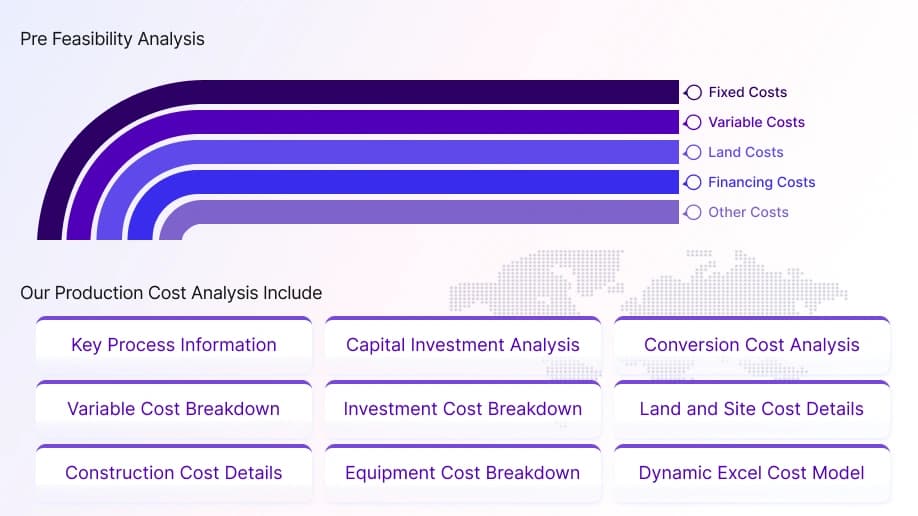
The report provides a detailed analysis essential for establishing a soda ash production plant. It encompasses all critical aspects necessary for soda ash production, including the cost of soda ash production, soda ash plant cost, soda ash production costs, and the overall soda ash production plant cost. Additionally, the study covers specific expenditures associated with setting up and operating a soda ash production plant. These encompass production processes, raw material requirements, utility requirements, infrastructure needs, machinery and technology requirements, manpower requirements, packaging requirements, transportation requirements, and more.
Soda ash, commonly known as sodium carbonate is a crystalline powder which is classified as major industrial chemical, utilised in the production of a variety of items such as glass, detergents, paper, and textiles. It is used as a water softener and alkaline agent in the manufacture of detergents and other cleaning goods. Soda ash is used in agriculture as a salt supply and to balance soil PH. It is used as a bleaching agent and pH stabiliser in the manufacture of pulp and paper. It is also utilised in the treatment of water and wastewater, as well as the manufacture of food and pharmaceutical products.
As the global population and living standards rise, so does the demand for domestic cleaning products, which drives demand for soda ash. Soda ash has high alkalinity and is a strong base, making it helpful in a variety of industrial applications. Applications for soda ash in the environment include flue gas desulfurization and the treatment of water and wastewater. With tighter environmental regulations, soda ash utilization in these applications is expected to increase the demand for this commodity which will promote its market expansion among various sectors.
Soda ash finds its extensive application as a water softener, alkaline agent, bleaching agent, pH stabilizer, food process, and glass production in water treatment, synthetic detergents & soap, agricultural, paper, food and glass industries. Moreover, the availability and cost of production of Soda ash’s raw materials, Soda ash market prices, storage and handling requirements, transportation and logistics, quality of soda ash, sustainability practices, etc., are some elements that influence industrial soda ash procurement. The global procurement of this commodity is greatly influenced by its necessity as a key component for the glass, paper, agriculture, detergent, and water treatment industries.
Raw Material for Soda ash Production
According to the Soda ash production plant project report, the major raw materials for Soda ash production include Propylene-Syngas; Propene; Ethanol; Butyraldehyde-Hydrogen.
Production Process of Soda Ash
The extensive Soda ash production cost report consists of these major industrial production processes:
- Production from Solvay Process: In this process sodium bicarbonate is precipitated by the Solvay process, which involves mixing brine with ammonia and carbon dioxide. Sodium carbonate, which is also known as soda ash, is produced by drying and heating this precipitate (Sodium bicarbonate).
- Production from Leblanc Process: In this process sulfuric acid is used to treat common salt (NaCl) to create salt cake (sodium sulfate). After that, it is burned with coal, limestone (CaCO3), or chalk to create black ash, which consisted primarily of calcium sulfide and sodium carbonate. Further, the sodium carbonate, commonly known as “Soda Ash” is dissolved in water and crystallized.
Soda ash, or butyl alcohol, is a four-carbon alcohol having five isomeric structures. It can be made using algae or diatoms only employing a solar-powered biorefinery. It has four isomeric structures, n-butanol, 2-butanol, iso-butanol, and tet-butanol. Soda ash is a C4 alcohol with molecular formula C4H9OH and has a calorific value of 29.2 MJ/dm3, and it has a low heat of vaporization (0.43 MJ/kg) and lower Reid vapour pressure. Soda ash is immiscible in water and has a higher energy content. Also, it is less corrosive in comparison to ethanol.
Its energy density is like that of gasoline and greater than ethanol and methanol. It is less hygroscopic and corrosive than ethanol which makes it easily transportable in pipelines which should be transported in trucks or barges. It appears to be a colourless liquid with medium volatility and has a smell like a banana. The solvent is also flammable and has a flashpoint of around 35° C. Its Molecular Mass is 74.12, and its boiling, and melting point is 117 °C (242.6 °F) and -90 °C (-130 °F).